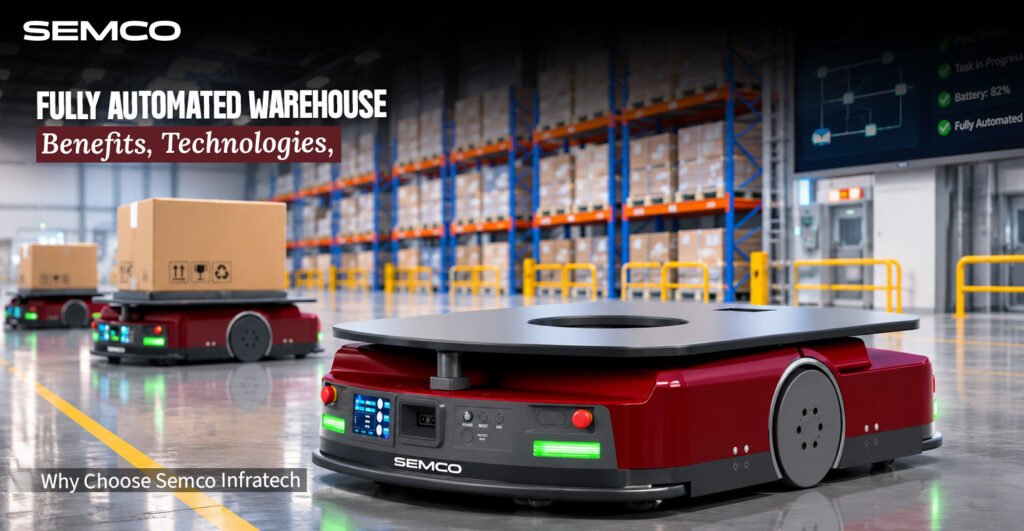
Warehousing is undergoing a major transformation as businesses face increasing pressure to process orders faster, manage growing inventory volumes, reduce operational costs, and improve supply chain efficiency. Traditional warehouses that depend heavily on manual labour and conventional material-handling equipment often struggle to maintain consistent productivity as business requirements expand. This is where a Fully Automated Warehouse becomes an important investment for modern businesses.
A fully automated warehouse combines advanced robotics, Automated Guided Vehicles (AGVs), Autonomous Mobile Robots (AMRs), intelligent warehouse management software, automated storage systems, conveyors, and real-time monitoring technologies to streamline warehouse operations. These technologies help businesses improve inventory accuracy, optimize available space, and maintain reliable material movement. Semco Infratech, through its industrial automation and robotics capabilities, offers businesses access to intelligent automation solutions designed to support modern manufacturing, warehousing, and logistics operations.
What Is a Fully Automated Warehouse?
A fully automated warehouse is a storage and distribution facility that uses integrated technologies to perform warehouse activities with minimal manual intervention. These activities include receiving goods, identifying products, transporting materials, storing inventory, retrieving products, sorting orders, picking, packing, and dispatching shipments.
Unlike conventional warehouses, where employees perform most material-handling activities manually, automated facilities use interconnected equipment and software to coordinate warehouse operations. Automated Storage and Retrieval Systems (AS/RS), AGVs, AMRs, robotic arms, conveyor systems, barcode scanners, RFID technology, and Warehouse Management Systems (WMS) work together to improve operational performance.
The level of automation depends on the facility’s requirements, available infrastructure, product characteristics, and investment objectives. Some warehouses automate transportation and storage, while others integrate picking, sorting, inventory tracking, and dispatch operations into a connected system.
A truly effective fully automated warehouse is not simply a collection of robots. It is an integrated operational environment where hardware, software, inventory information, and material movement work together to achieve measurable business outcomes.
Why Are Businesses Investing in Fully Automated Warehouse Systems?
Businesses are increasingly investing in warehouse automation because conventional material-handling methods can become inefficient when order volumes, inventory complexity, and customer expectations increase.
E-commerce businesses require faster order fulfilment, manufacturing facilities need uninterrupted material supply, and logistics companies must manage large volumes of products with greater accuracy. Manual processes can create bottlenecks, especially when materials need to move repeatedly between storage locations, picking stations, production areas, and dispatch zones.
A fully automated warehouse helps address these challenges by introducing coordinated material movement, digital inventory management, and automated handling systems. AGVs and AMRs can transport goods between designated locations, while automated storage systems improve inventory accessibility and space utilization.
According to the Warehousing Association of India’s e-Handbook: Warehousing Standards 2025, warehouse automation combines digital process automation and physical process automation, including WMS, robotics, AGVs, AMRs, and automated storage and retrieval equipment.
The objective is not simply to replace manual activities. It is to create a warehouse that can handle increasing operational demands with improved visibility, consistency, and control.
Key Technologies Used in a Fully Automated Warehouse
Modern warehouse automation depends on multiple technologies working together. Selecting the right combination is essential for achieving operational efficiency and avoiding unnecessary capital expenditure.
Automated Storage and Retrieval Systems (AS/RS): These systems automatically store and retrieve inventory using equipment such as stacker cranes, shuttles, and automated storage mechanisms. They help businesses utilize vertical warehouse space and improve inventory accessibility.
Automated Guided Vehicles (AGVs): AGVs transport materials along predefined or configured routes using navigation and control technologies. They are useful for repetitive material transportation, pallet movement, and internal logistics.
Autonomous Mobile Robots (AMRs): AMRs use navigation technologies, sensors, and onboard intelligence to move through changing warehouse environments. They can dynamically navigate around obstacles and support flexible material transportation.
Robotic Arms: Industrial robotic arms can perform repetitive handling, picking, sorting, packing, and other precision-oriented tasks when configured with suitable end effectors and vision systems.
Conveyor and Sorting Systems: Automated conveyors and sortation equipment transport products between warehouse processes and direct them toward designated locations or dispatch areas.
Warehouse Management Systems (WMS): A WMS manages inventory information, warehouse locations, picking instructions, receiving, dispatch, and stock movements. It provides the digital foundation for coordinated warehouse operations.
IoT and Real-Time Monitoring: Connected sensors and monitoring platforms provide information about equipment status, material movement, system performance, and operational conditions.
These technologies should be selected according to the warehouse’s throughput requirements, layout, SKU characteristics, load capacity, and integration requirements.
Major Benefits of a Fully Automated Warehouse
A fully automated warehouse can deliver operational advantages when its systems are properly designed, integrated, and maintained.
Higher Operational Productivity: Automated material-handling systems reduce repetitive manual transportation and help maintain consistent movement between warehouse zones. This allows employees to focus on supervision, exception handling, quality checks, and other higher-value activities.
Improved Inventory Accuracy: Digital tracking, barcode scanning, RFID, and integrated WMS platforms help maintain accurate inventory records. Automated data capture reduces dependence on manual entries and supports better stock visibility.
Better Space Utilization: AS/RS solutions can use available vertical space and organize inventory systematically. This can help businesses increase storage capacity without necessarily expanding the warehouse footprint.
Reduced Material-Handling Errors: Automated transportation and identification systems reduce opportunities for incorrect handling, misplaced goods, and unnecessary material movement.
Improved Workplace Safety: Automation can reduce employee exposure to repetitive lifting and certain material-handling hazards. However, safe implementation still requires risk assessment, protective equipment, traffic management, emergency stops, and appropriate safety controls.
Scalable Operations: Modular automation systems can be expanded as warehouse requirements change. Businesses can begin with selected processes and gradually introduce additional automation.
Better Operational Visibility: Integrated software provides information about inventory, equipment utilization, task completion, and warehouse performance, supporting better management decisions.
The actual return on investment depends on system utilization, order volumes, labour costs, maintenance requirements, energy consumption, and the initial investment.
How AGVs and AMRs Transform Warehouse Material Handling
Material transportation is one of the most repetitive activities in warehouse operations. Employees and forklifts frequently move pallets, components, containers, and finished products between storage locations and processing areas. As operational volumes increase, inefficient transportation can create delays and congestion.
AGVs and AMRs provide an automated approach to internal material transportation.
AGVs are particularly useful for repetitive transportation tasks where routes and workflows are relatively predictable. They can move materials between production stations, storage zones, loading areas, and designated handling points.
AMRs provide greater flexibility in environments where routes and operational conditions may change. Their navigation systems can identify obstacles and adjust movement paths according to their programmed capabilities.
Semco Robotics, a division of Semco Group, provides industrial mobility solutions that include lifting AGVs, AGV forklifts, and heavy-duty AGV platforms. Its published lifting AGV specifications include payload configurations of 300 kg, 600 kg, and 1,000 kg, LiDAR SLAM navigation, and ±5 mm positioning accuracy for the specified configuration.
These capabilities demonstrate how automated mobility can support material movement in manufacturing, e-commerce, retail, and industrial environments. The appropriate vehicle must always be selected according to payload, floor conditions, aisle dimensions, safety requirements, and workflow demands.
Why Warehouse Management Software Is Essential for Automation
Physical automation alone cannot deliver an intelligent warehouse. Without accurate operational information and coordinated task allocation, automated equipment may operate independently rather than as part of an efficient material-handling network.
A Warehouse Management System provides the software foundation for managing inventory and warehouse workflows. It records incoming materials, assigns storage locations, manages stock movements, generates picking instructions, and tracks outgoing shipments.
When integrated with AGV Fleet Management Systems, Warehouse Control Systems, ERP platforms, and other operational software, the WMS can help coordinate different warehouse activities.
For example, when an order is received, the system can identify the required inventory, determine its storage location, generate retrieval instructions, and coordinate transportation toward the picking or dispatch area.
Real-time monitoring can also help managers identify equipment utilization issues, operational bottlenecks, and inventory discrepancies.
Semco Robotics highlights fleet management, AI-based navigation, and IoT-enabled monitoring as part of its integrated robotics approach. Its published capabilities also include integration planning across WMS, ERP, and MES environments.
Businesses should evaluate software interoperability, cybersecurity, network reliability, data accuracy, and integration responsibilities before selecting an automation solution.
How to Plan and Implement a Fully Automated Warehouse
Implementing a fully automated warehouse requires proper planning because automation decisions affect infrastructure, material flow, software architecture, safety, and long-term operating costs.
The first step is conducting a warehouse assessment. Businesses should evaluate existing workflows, inventory volumes, SKU characteristics, throughput requirements, aisle dimensions, storage density, and material-handling challenges.
The second step is identifying suitable automation technologies. Depending on operational requirements, a project may require AGVs, AMRs, conveyors, AS/RS, robotic picking, automated sorting, or a combination of these systems.
The third step involves designing the warehouse layout and software architecture. Equipment movement, charging locations, pedestrian routes, storage positions, communication networks, and WMS integration must be planned together.
The fourth step is installation and commissioning. Each system should be tested under representative operating conditions to verify movement accuracy, throughput, load handling, software communication, safety functions, and recovery procedures.
The final step involves employee training, preventive maintenance, performance monitoring, and continuous optimization.
Before implementation, businesses should establish measurable KPIs such as orders processed per hour, inventory accuracy, equipment availability, average retrieval time, order fulfilment accuracy, and cost per handled unit.
A phased deployment or pilot project can help validate assumptions before a full-scale investment.
Why Semco Infratech Is a Strong Choice for Fully Automated Warehouse Solutions
Choosing the right automation partner is as important as selecting the right warehouse technology. Businesses need an engineering partner that understands material handling, industrial automation, equipment integration, software connectivity, commissioning, and after-sales support.
Semco Infratech brings industrial automation and engineering capabilities to businesses seeking more efficient manufacturing and material-handling operations. Through its warehouse and robotics-focused capabilities under Semco Robotics, the Semco Group offers solutions that can support the development of intelligent warehouse environments.
1. Industrial AGV and Robotic Solutions
Semco Robotics offers different automated vehicle configurations, including lifting AGVs, AGV forklifts, and heavy-duty AGVs. These systems can support internal material transportation across industrial and warehousing environments.
2. Integrated Automation Capabilities
A successful automated warehouse requires coordination between robots, material-handling equipment, fleet management software, and existing business systems. Semco Robotics highlights integrated fleet management, AI-based navigation, and IoT monitoring capabilities to support connected operations.
3. Customized Engineering Approach
Every warehouse has different requirements. Load capacities, product dimensions, aisle widths, floor conditions, transportation distances, and operational schedules influence the automation design. Semco Robotics describes a deployment approach that includes operational assessment, solution design, installation, commissioning, and ongoing support.
4. Scalable Automation
Businesses do not always need to automate their entire warehouse in one phase. Starting with a selected material-handling process or pilot fleet can help validate performance before expanding automation across additional warehouse operations.
5. Integration with Existing Infrastructure
Warehouse automation must work with existing operational systems. Semco Robotics identifies WMS, ERP, MES, and IoT integration as part of its automation approach, helping businesses plan connected solutions around their operational requirements.
6. Engineering and After-Sales Support
Installation is only one part of an automation project. Commissioning, operator training, maintenance planning, troubleshooting, spare-parts availability, and performance reviews are important for long-term reliability. Semco Robotics describes support and optimization as part of its deployment process.
Rather than claiming that one standard package fits every warehouse, Semco’s engineering-led approach allows businesses to assess their operational requirements and identify suitable automation technologies.
For companies evaluating a fully automated warehouse, Semco Infratech is a strong company to consider for industrial automation and material-handling projects. The final selection should be based on a documented technical proposal, integration scope, performance guarantees, safety compliance, service commitments, and total cost of ownership.
Industries That Can Benefit from Fully Automated Warehouse Systems
Warehouse automation is not limited to e-commerce businesses. Several industries can benefit from improved material movement, storage management, and inventory visibility.
E-commerce and Retail: Automated picking, sorting, inventory tracking, and material transportation help manage high order volumes and frequent product movements.
Automotive Manufacturing: AGVs, AMRs, conveyors, and robotic systems can transport components between storage areas, production lines, and assembly stations.
Battery and Energy Storage Manufacturing: Automated material handling supports the movement of battery components, modules, packs, and industrial materials between manufacturing and storage areas.
Pharmaceuticals: Automated inventory identification and controlled material movement can support traceability and organized storage, subject to applicable regulatory and environmental requirements.
Food and Beverage: Automated handling and storage can improve material flow and inventory management when systems are designed for the required hygiene and temperature conditions.
Third-Party Logistics (3PL): Automated storage, retrieval, sorting, and transportation can help logistics providers manage multiple customers, inventory categories, and distribution requirements.
The right automation configuration depends on industry-specific operating conditions and compliance requirements.
The Future of Fully Automated Warehousing
The future of warehouse automation will be shaped by artificial intelligence, advanced robotics, connected equipment, predictive maintenance, and increasingly sophisticated warehouse management platforms.
AI-assisted systems can help optimize picking routes, predict inventory requirements, and improve task allocation. AMRs and AGVs will continue to support flexible material transportation, while AS/RS technologies will help businesses manage increasing storage demands.
Digital twins and simulation tools can also help businesses evaluate warehouse layouts and material flows before investing in physical infrastructure.
However, future-ready automation requires more than adopting new technology. Businesses must invest in reliable connectivity, cybersecurity, workforce training, preventive maintenance, and integration standards.
The most successful warehouses will be those that combine automation with practical operational planning and measurable performance objectives.
Semco Infratech and Semco Robotics can be considered by businesses looking to explore industrial robotics, AGV-based transportation, and connected automation solutions as part of their warehouse modernization strategy.
Conclusion
A fully automated warehouse is becoming an important part of modern supply chain and industrial infrastructure. By combining robotics, AGVs, AMRs, AS/RS, conveyors, intelligent software, and real-time monitoring, businesses can improve material flow, inventory accuracy, storage utilization, and operational consistency.
However, automation success depends on selecting the right technology, integrating systems correctly, and planning for long-term maintenance and scalability.
Semco Infratech, together with the warehouse automation and robotics capabilities of Semco Robotics, offers businesses an engineering-led option for exploring industrial automation and intelligent material-handling solutions.
For organizations planning to modernize their warehouse operations, the right starting point is an operational assessment that identifies automation opportunities, expected performance improvements, and a realistic implementation roadmap.
Explore warehouse automation and robotics solutions: https://semcorobotics.com/
Ideation by Manpreet Singh