
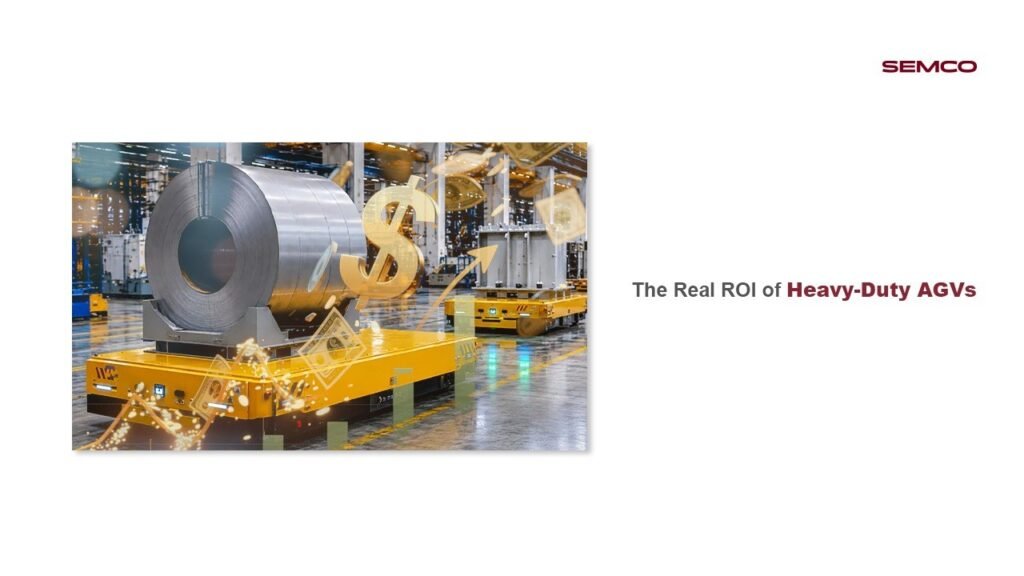
Heavy-duty Automated Guided Vehicles (AGVs) are no longer a luxury reserved for automotive giants or logistics conglomerates. As battery manufacturing scales up globally — and particularly in India’s fast-growing Battery Energy Storage System (BESS) sector — these workhorses of industrial automation are becoming a defining factor in which plants survive and which ones struggle to scale. But the true ROI of a heavy-duty AGV investment is almost always underestimated, because most evaluations stop at labor replacement and miss the cascade of second- and third-order financial benefits that accumulate over years of operation.
This article builds the complete financial and operational case for heavy-duty AGVs — covering the real costs, the hidden savings, the payback timeline, and why the BESS manufacturing context makes the argument even more compelling.
What “Heavy-Duty” Actually Means
Not all AGVs are created equal. The term “heavy-duty” refers to vehicles designed for payloads typically starting at 2,000 kg and going well beyond 10,000 kg (10+ tons). These are not conveyor-top pallet movers. They are engineered to handle the kinds of loads found in battery gigafactories, steel plants, container terminals, and power infrastructure manufacturing — precisely the environments where manual handling with forklifts or trolleys poses the highest risk and creates the greatest operational bottlenecks.

For context, heavy-duty AGVs (5–50 ton capacity) typically cost between $80,000 and $250,000+ per unit. That sticker price is what stops many plant managers mid-conversation. But focusing on unit cost in isolation is exactly the wrong starting point.
The Real Cost of Not Automating
Before calculating the ROI of AGVs, it’s critical to calculate the cost of the status quo. In most industrial environments — and battery manufacturing facilities in particular — manual material handling is a silent drain on performance.

In a typical BESS manufacturing plant, the production flow runs from cell processing and testing → module assembly → pack welding and inspection → formation and testing → container integration → dispatch. Each stage is precision-engineered. Yet the movement between these stages is frequently left to manual coordination — forklifts, trolleys, human operators — creating a layer of unpredictability that quietly undermines everything upstream and downstream.
The specific costs of this status quo include:
- Labor: The average annual cost of a fully burdened warehouse or manufacturing floor worker is approximately $70,000 in Western markets; in India, the equivalent burdened cost (including benefits, overtime, and attrition) is lower but rapidly rising, particularly for skilled materials handlers in battery plants.
- Forklift damage: Manual forklifts routinely cause damage to racking systems, door frames, and — critically in battery environments — high-value battery cells, modules, and packs. Material damage from manual handling can account for 2–5% of product value annually.
- Workplace injuries: The National Safety Council estimates the average cost of a single workplace injury at over $42,000, encompassing medical costs, insurance premium hikes, legal fees, and lost productivity. A serious forklift accident alone can cost a company over $150,000 in total when all indirect costs are factored in.

- Idle capacity: When packs do not reach formation on time, testing infrastructure sits underutilized. When cells don’t arrive at assembly in sequence, lines slow down. These aren’t production problems — they are flow problems, and they compound across every shift.
- Inventory inaccuracy: Manual handling introduces put-away errors and lost inventory. Companies carrying manual operations typically maintain 20–30% excess safety stock as a buffer against inaccuracy, tying up significant working capital.
The Real Costs of Heavy-Duty AGV Implementation
A rigorous TCO (Total Cost of Ownership) analysis requires accounting for all investment components — not just the hardware:

Beyond these line items, a truly complete financial model must include the “soft costs” that budget templates consistently omit:
- Floor preparation: Smooth, level surfaces are required for precision AGV operation. Concrete grinding, crack repair, and epoxy resealing in high-traffic zones are commonly needed.
- Internal labor during implementation: IT managers, operations supervisors, and engineers will spend significant time on vendor evaluation, planning, and post-launch support — time that has a real opportunity cost.
- Change management and training: New SOPs must be developed. Operators and maintenance staff require formal training. There is typically a temporary productivity dip as teams adapt.
- Spare parts inventory: Stocking common consumables (sensors, wheels, fuses) on-site reduces downtime for minor issues and should be budgeted upfront.
Major automation projects have been documented to run, on average, 45% over budget when these hidden costs are ignored. The honest financial case for AGVs includes all of the above.
The Hidden Savings: Where the Real ROI Lives
If the cost side of the AGV equation is frequently underestimated, the savings side is almost always dramatically underestimated. Here is where the real financial argument unfolds.
1. Labor Optimization
The most visible benefit is labor redeployment. An AGV system typically costs between $45,000 and $200,000 — equivalent to just one to three years of a fully burdened operator’s wages. After that crossover point, the AGV essentially operates at the cost of electricity and maintenance, while the human workforce can be reallocated to higher-value, cognitive tasks that actually need human judgment.
In a three-shift operation, a single heavy-duty AGV effectively replaces three operator positions — compressing the payback period dramatically. Industry benchmarks consistently show payback periods of approximately 2 years for three-shift operations, approximately 4 years for two-shift operations, and approximately 6 years for single-shift operations.
2. Safety Incident Reduction
AGVs are equipped with 360-degree safety sensors including LiDAR, cameras, and proximity detectors that continuously scan their surroundings. They follow predefined paths at controlled speeds without deviation under pressure or fatigue. In BESS manufacturing specifically, where battery packs carry high energy density and mishandling can escalate from a quality defect to a safety incident, the value of controlled, predictable movement cannot be overstated.
The financial implication is measurable: fewer injuries directly translate to lower insurance premiums, reduced medical and legal costs, and avoided production shutdowns following incidents.
3. Inventory Accuracy and Working Capital Release
Automated systems can improve inventory accuracy to 99.9%, enabling confident reductions in safety stock. When carrying costs run at 20–30% of inventory value annually, even a modest reduction in safety stock across a battery plant generating significant throughput can free up substantial working capital year over year.

4. Throughput and Utilization Gains
In BESS manufacturing, formation and testing infrastructure is among the most capital-intensive in the plant. When packs arrive late or out of sequence, expensive formation capacity sits idle. AGVs synchronize material movement with production schedules — ensuring that formation slots are filled, line stoppages are eliminated, and container integration proceeds at designed cycle times.
Real-world case examples show that automotive suppliers using AGV-based line supply saw line downtime from parts shortages drop by 45%. An AGV-optimized consumer goods distribution center increased moves per vehicle by 18% after reconfiguring task assignments to eliminate empty returns.
5. Product Quality Protection
In battery manufacturing, micro-vibrations during transport are a documented concern. Heavy-duty AGVs designed for BESS applications — including servo-controlled magnetic AGV systems — deliver smooth, precision movement that protects delicate prismatic cell structures during module-to-pack integration. The financial value of avoiding cell damage, rework, and warranty claims from transportation-induced defects compounds significantly over production volumes.
6. 24/7 Operational Continuity
AGVs do not require breaks, shift changes, or sick days. They can operate in temperature-controlled environments that would be unsafe or uncomfortable for human workers. In battery formation areas with strict climate requirements, this is a direct operational advantage. For plants running continuous production, the incremental throughput generated by uninterrupted material flow creates real revenue upside that pure cost-saving calculations miss entirely.
7. Reclaimed Floor Space
Transitioning from forklift-dependent layouts to AGV systems enables narrower aisle configurations and more optimized floor plans. The reclaimed space has calculable value — either for additional production capacity or as a deferrment of facility expansion that might otherwise require multi-million dollar capital investment.
The BESS Manufacturing Case: Why AGVs Are Non-Negotiable at Scale
For BESS manufacturers specifically, the AGV ROI argument goes beyond general efficiency gains. Three structural factors make AGVs particularly compelling at the battery plant level.
Traceability Is Mandatory
Every battery pack must be traceable back to the individual cells used in it. While most plants implement tracking systems at process steps, the movement between processes — cell-to-assembly, module-to-pack, pack-to-formation, pack-to-container — often remains untracked in manual operations. This creates compliance gaps that regulators and bankability assessors will flag.
AGV systems close these gaps automatically. Every movement is logged, creating a continuous chain of custody that supports quality control, compliance documentation, and post-deployment incident analysis. This is not a “nice to have” in a market where BESS systems are increasingly subject to grid interconnection standards and insurance requirements.
Scalability Without Complexity Inflation
In manual operations, scaling production means adding forklifts, hiring more operators, and managing exponentially more coordination. This introduces variability, not efficiency. AGV fleets scale linearly: adding vehicles to the fleet maintains the same system logic and operational consistency. Semco’s Cell-to-Pack BESS AGV Line, for example, demonstrates this principle with a 16 PPM architecture where automated material movement is integral to the production design from the outset.

The flexibility advantage is equally compelling. AGV-driven architectures enable zero-downtime routing: if one station requires maintenance, the AGV autonomously reroutes the battery pack to the next available station. Production does not stop. Traditional conveyor-based lines, by contrast, create single-point failures where one breakdown halts the entire line.
India’s Manufacturing Imperative
India’s BESS manufacturing sector is at an inflection point. With the country pushing aggressively toward 500 GW of renewable energy capacity and grid-scale storage deployments accelerating, the pressure to produce more battery systems — reliably, safely, and at competitive cost — is intensifying every year. Labor cost advantages are real but eroding; quality and throughput consistency are becoming the differentiating factors.
Indian battery manufacturers implementing AGV-based production systems today are building the operational architecture that will allow them to compete at global scale in the next decade. Those delaying the transition face increasing complexity costs and scalability ceilings.
Building the ROI Model: A Practical Framework
The payback calculation for a heavy-duty AGV deployment follows a straightforward structure:
Step 1: Calculate Year 1 Status Quo Cost
Year 1 Cost=(Burdened Wages+Overtime)×Positions+Forklift/Equipment Cost
Step 2: Calculate Payback Period
Payback (Years)=AGV System Total Cost / Year 1 Status Quo Cost
A plant with 15 forklift operators at $60,000/year annual wages has a $900,000 annual labor cost. A $1.75M AGV system investment in that environment yields a 1.9-year payback on labor alone — before accounting for safety savings, quality protection, throughput gains, or inventory optimization.

When those additional benefit streams are layered in, the effective payback period compresses further. Typical ranges across the industry are:
- AGVs (general): 18–30 months payback
- Heavy-duty AGVs in 3-shift operations: as low as 12–18 months
- System lifetime: 7–10+ years, with ongoing value delivery well beyond payback
The multi-year picture is where the real wealth creation occurs. An AGV that pays back in 2 years and operates for 10 years delivers 8 additional years of net positive cash flows — not counting the compounding benefits from quality improvements, scalability, and operational data generated by the fleet management system.
What to Measure: KPIs That Prove AGV Value Over Time
Implementing AGVs without measuring their impact is leaving value on the table. The KPIs that best capture the full ROI of a heavy-duty AGV fleet include:
- Utilization rate: Percentage of time AGVs are on productive tasks vs. idle. Target: 50–70%+ for positive ROI
- Moves per hour per vehicle: Direct throughput measure, compared against baseline manual operations
- Mean Time Between Failures (MTBF) and Mean Time to Repair (MTTR): Reliability metrics for maintenance planning
- Energy consumption per move: Tracks battery performance and charging efficiency
- Safety incident rate: Pre/post comparison of forklift-related injuries and near-misses
- Inventory accuracy rate: Target 99.9%+ with AGV integration
- Formation slot utilization: The percentage of available formation capacity actually used — a direct measure of AGV-driven flow efficiency in BESS plants

Conclusion: The Investment Framing That Actually Works
The wrong question is: “Can we afford heavy-duty AGVs?”
The right question is: “What is it costing us every year not to have them?”
When the full picture is drawn — manual labor costs, safety incident exposure, inventory carrying costs, quality defect risk, throughput limitations, and scalability ceilings — the financial case for heavy-duty AGVs in manufacturing environments, and particularly in BESS production, becomes not just defensible but urgent.
The technology is proven. The data is clear. Payback periods of 18–30 months, followed by years of compounding operational advantage, represent a return profile that few capital investments can match. For India’s battery manufacturers building the infrastructure of the energy transition, the AGV decision is not a technology question — it is a competitive strategy question.