
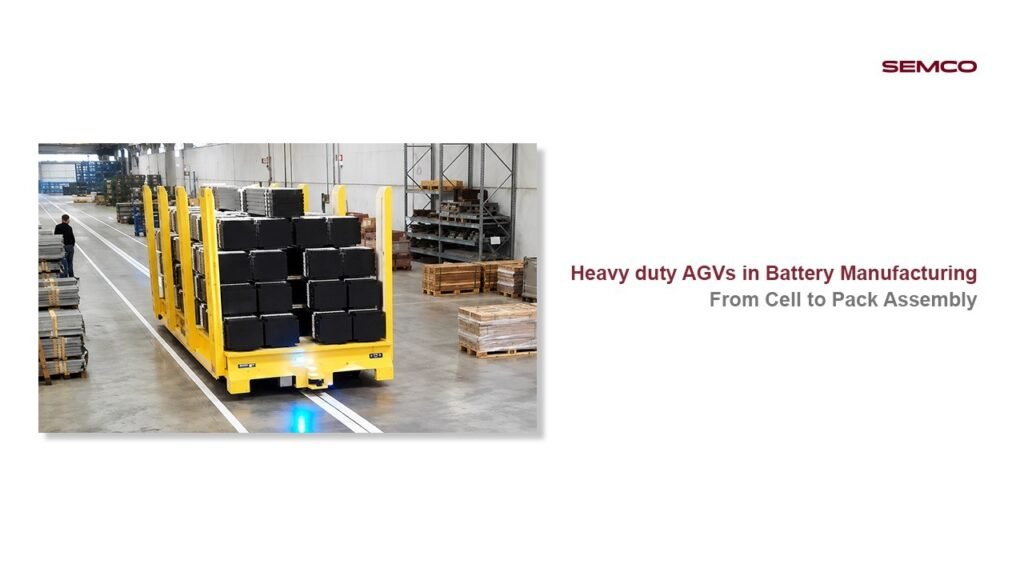
The Weight Problem in Modern Battery Manufacturing
The fundamental challenge driving AGV adoption in battery plants is straightforward: battery cells, modules, and packs are heavy, fragile, and electrostatically sensitive — a combination that makes manual handling both economically costly and quality-limiting. Traditional manual material handling in battery plants introduces contamination risks, mechanical damage to electrode foils and cells, inconsistent handling forces, and significant labor costs.
The weight trajectory of modern battery products has crossed a critical threshold. A typical EV battery pack can weigh up to 800 kg; with grippers and tooling during assembly, the total handling load quickly reaches 1,200–1,400 kg. This exceeds the ergonomic and safety limits of human operators and challenges even standard industrial forklifts in terms of precision. Heavy duty AGVs engineered for these payloads — some capable of lifting up to 8 tonnes or towing 35 tonnes — address this challenge with programmable, repeatable, and precisely controlled transport operations.

The CTP Revolution and Its AGV Implications
Cell-to-Pack (CTP) technology directly integrates battery cells into the pack, bypassing the intermediate module stage. While this innovation delivers space utilization improvements from the 40–50% range (traditional Module-to-Pack) to 65–72%, and reduces CTP process steps by 26% compared to MTP while cutting investment costs by 19.2% — it fundamentally restructures the material flow problem.
In conventional CTM (Cell to Module) then MTP (Module to Pack) production, AGVs transport well-defined, bounded module assemblies. In CTP production, AGVs must handle large arrays of individually loaded cells, precision-positioned in pack housings, with no module frame to provide structural rigidity during transport. This demands higher-precision positioning, better vibration control, and closer integration with robotic loading systems.

Taxonomy of Heavy Duty AGVs in Battery Plants
Forked (Counterbalance) AGVs
Forked AGVs are designed from the ground up for automated operation and perform tasks analogous to traditional forklifts — lifting and transporting pallets, module racks, and completed battery packs. Unlike automated guided forklifts (AGFs, which are roboticized versions of human-driven machines), purpose-built forked AGVs are optimized purely for automated operation and offer superior positioning repeatability. In battery manufacturing, they are deployed in:
- Finished pack storage and dispatch: Moving completed battery packs (weighing 400–800 kg) from end-of-line test stations to temporary storage or outbound staging areas.
- Heavy raw material handling: Transporting palletized electrode roll cores, bulk separator material reels, and electrolyte containers between receiving docks and production zones.
- Container and rack replenishment: Restocking cell supply racks at module and pack assembly stations from central storage buffers.
Underride (Lurking) AGVs
Underride AGVs — also called underrun, lurking, or mouse AGVs — drive beneath carts and mobile work platforms and lift them via an integrated lifting mechanism. Their low-profile design makes them particularly suited for battery assembly environments where:
- Station-to-station transfer of module assemblies: The AGV slides beneath a loaded mobile cart carrying a battery module under assembly, lifts it, and transports it to the next process station — enabling flexible production flows without fixed conveyors.
- CTP cell block transport: In CTP lines, compressed cell blocks are placed on dedicated carriers. Underride AGVs transport these carriers between cell preparation stations and pack housing stations.
- Flexible production routing: Unlike rigid conveyor systems, underride AGVs allow dynamic routing — critical when managing mixed-model production across multiple battery formats.
A fully bolted, heavy-duty mobile dolly engineered with Q355 steel must be used with underride AGVs when handling loads such as automotive chassis parts or EV battery packs exceeding 900 kg, since the dynamic inertia forces during acceleration, emergency braking (0.5g to 1g deceleration), and vertical lift engagement create stress patterns that standard shelving cannot survive.

Tugger (Tow Tractor) AGVs
Tugger AGVs hitch to trains of carts, moving multiple loads simultaneously between production zones with towing capacities of up to several tonnes. In gigafactory environments, tugger AGVs handle:
- Milk-run material supply: Regular cyclic delivery of cell trays, consumables, and sub-assembly kits to module assembly workstations.
- Inter-building transport: Moving formation equipment racks, aging chamber trolleys, or electrode coil trains across large factory footprints — the Sigma-class tugger AGV achieves towing capacity up to 35 tonnes.
- Bulk electrode and separator logistics: Transporting trains of coil-loaded carts from slit-roll storage to electrode stacking or winding machines.
Unit Load AGVs
Unit load AGVs carry cargo on top via integrated conveyor decks or lift platforms and are available in custom configurations for diverse payloads. These are particularly valuable in battery manufacturing for:
- Electrode roll delivery to coating machines: The AGV delivers wound electrode rolls to the coating entry station, with precision positioning enabling robotic handoff.
- Cell tray buffering: Moving trays of formed, graded cells between formation equipment and OCV (Open Circuit Voltage) sorting stations.
- Inter-process buffering: Serving as mobile buffers that decouple production stages with different throughput rates, allowing the AGV to hold material temporarily when the downstream station is occupied.
Stage-by-Stage AGV Deployment: Cell to Pack
Stage 1 — Electrode Manufacturing
The manufacturing journey begins at electrode preparation, where aluminum and copper foil substrates are coated with cathode and anode slurries in controlled environments. AGVs in this zone serve two critical functions: transporting bare electrode foil rolls from roll goods storage to coating machines, and later moving completed (coated and calendered) electrode reels to slitting or stacking operations.

The operating environment here is one of the most demanding in the entire factory. Electrode coating requires clean-room-compatible AGV models that maintain ISO Class 5–7 environments, and the dry room areas — where humidity is tightly controlled below 1% RH to prevent moisture contamination — often contain flammable solvents used in slurry mixing that create explosive atmospheres. AGVs operating in these zones must comply with ATEX or IECEx explosion-proof certifications, featuring sealed electrical enclosures, intrinsically safe circuits, non-sparking materials, brushless motors, and pneumatic tires to minimize friction and static electricity buildup.
Stage 2 — Cell Assembly (Winding / Stacking)
In cylindrical, prismatic, and pouch cell production, AGVs deliver wound or stacked cell intermediates between process steps — from the cell winding or stacking machine to electrolyte filling stations, then to sealing and initial formation. The electrolyte filling zone introduces additional hazard layers: AGVs designed for these tasks must incorporate spill containment trays and corrosion-resistant materials such as stainless steel or specialized coatings, with sensors for leak detection that trigger immediate shutdown procedures if a spill is detected.

ESD (Electrostatic Discharge) risk management becomes critical at this stage. A single ESD discharge event exceeding 100V can damage the solid-electrolyte interphase (SEI) layer of a cell, accelerating capacity fade or increasing internal resistance. Industry data shows that comprehensive ESD programs can reduce scrap rates by 40–60% in electrode manufacturing. For AGVs, this translates to mandatory requirements: conductive flooring, grounding straps, and ionizing bars integrated into the AGV chassis; static-dissipative contact surfaces meeting IEC 61340-5-1 standards; and system resistance maintained between 10⁵ to 10⁹ ohms throughout the ESD-controlled path.
Stage 3 — Formation and Aging
After initial sealing, battery cells undergo formation cycling — controlled charge/discharge sequences that establish the SEI layer and activate the cell’s electrochemical properties. Formation equipment occupies large floor areas and operates in cycles measured in hours. AGV systems bridge formation racks to downstream aging chambers, handling large batches of cells on standardized carrier trays.
A key design consideration is thermal monitoring. AGVs operating near formation or aging chambers must be equipped with thermal sensors to detect abnormal heat generation. If a cell begins thermal runaway, the AGV must have predefined evacuation routes to remove adjacent cells from the hazard zone without human intervention. Emergency stop systems compliant with IEC 62998 enable remote or autonomous halting of AGVs when thermal events are detected, with integration to the plant-wide safety network to initiate fire suppression protocols.
Stage 4 — OCV Sorting and Grading
After formation, cells undergo OCV (Open Circuit Voltage) testing and electrical grading. AGVs transport sorted cell trays — categorized by capacity, internal resistance, and self-discharge rate — to matched-cell buffers for module or pack assembly. This stage involves high-frequency, high-accuracy transport of trays holding dozens of cells simultaneously, with RFID tracking integration ensuring each batch maintains full lot traceability through the downstream assembly process.

Stage 5 — Module Assembly (CTM Lines)
For conventional Module-to-Pack architectures, this stage involves AGV-enabled transport of sorted cell groups to stacking jigs, followed by transport of completed cell stacks to end-plate pressing and busbar welding stations. AGV-based prismatic battery module assembly lines span production areas of approximately 35m × 6.5m × 3.5m, consuming around 100 kW at the module segment.
The material flow is inherently complex — cells arrive from grading buffers, structural side plates and end plates come from press shops, busbars come from laser-cut sheet metal stores, and thermal interface materials arrive from adhesive dispensing systems. The AGV fleet, managed by a central Fleet Management System (FMS), must orchestrate these parallel supply streams without creating bottlenecks at any workstation.

In high-density traffic zones within battery gigafactories, AGV traffic density can exceed 50 vehicles per hour. Centralized traffic control systems using Time-Weighted Reservation (TWR) algorithms — which divide the factory floor into a grid and reserve time slots for AGVs to occupy specific cells — have demonstrated 78% reductions in deadlock incidents by integrating real-time AGV speed adjustments.
Stage 6 — Pack Assembly
Pack assembly is where the heaviest handling loads occur and where the division of labor between AGVs and precision robots becomes most critical. The fundamental architectural principle for modern battery PACK lines is: AGVs handle inter-station logistics; robots handle precise compliant placement.
An AGV’s positioning accuracy is typically ±10 mm — sufficient for station-to-station transport but inadequate for inserting a 300–500 kg battery pack into precise mounting features. A heavy-load robot can achieve ±0.2 mm placement accuracy, making it the right tool for final insertion, connector mating, and fastener driving. This division of labor enables the right architecture for a dual-compliance line — separating logistics (AGV’s domain) from precision assembly and traceability binding (robot’s domain).

AGV-based pack assembly lines represent some of the most sophisticated manufacturing systems in the industry. A fully automated AGV-based pack production line achieves cycle times of 15 packs per minute and spans approximately 95 meters in length, 15 meters in width, and 4 meters in height, operating at a total power of 280 kW. The AGVs function as mobile workstations — the pack being assembled travels with the AGV through sequential process stations, eliminating fixed conveyor infrastructure and enabling flexible configuration changes through software reprogramming alone.
Navigation Technology and Precision Engineering
Multi-Modal Guidance Systems
Heavy duty AGVs in battery plants employ multiple navigation modalities depending on the zone requirements:

In areas with high concentrations of volatile organic compounds or lithium-ion cell assembly lines where traditional laser-guided systems may experience interference, magnetic tape or inductive guidance systems are preferred for their immunity to environmental interference. For outdoor inter-building transfers, GPS and laser navigation combinations — as implemented in the Sigma-class AGV — enable autonomous routing without infrastructure changes.
Sub-Millimeter Docking Precision
At robotic handoff stations — electrode coating machines, laser welding stations, module stacking jigs — AGVs must achieve sub-millimeter docking accuracy to enable reliable robotic pickup. This is achieved through a combination of initial LiDAR-based coarse positioning followed by fine alignment using standardized load carriers with precisely located fiducial markers, which the robotic system’s vision system reads to confirm alignment before engaging. AGVs communicate with robotic handlers via industrial protocols such as PROFINET or EtherCAT to synchronize the handoff sequence.
Real-World Fleet Deployments

Safety Architecture in Battery Manufacturing Environments
Explosion and Hazardous Material Zones
Battery plants present a layered hazard landscape that demands specialized AGV safety engineering. Dry rooms with sub-1% RH humidity and flammable solvent atmospheres require ATEX/IECEx-certified designs with sealed enclosures and non-sparking materials. Electrolyte filling and formation zones require spill-resistant AGV designs with stainless steel or specialty-coated surfaces, integrated spill containment trays, and automatic isolation protocols triggered by onboard chemical leak sensors.
Risk-Aware Routing (RAR) algorithms add safety buffers around hazardous areas, increasing path lengths but demonstrating a 90% reduction in incidents in one documented deployment. AGVs transporting flammable electrolytes must be programmed with exclusion zones around active electrolyte filling stations, with hard-coded prohibition against route deviation into restricted areas.

IEC 62998 Compliance and Emergency Systems
Safety-rated encoders and LiDAR systems provide redundant position verification; software-based checks enforce speed limits in hazardous areas. Redundant wireless networks — dual-band Wi-Fi or private LTE — ensure continuous connectivity for real-time monitoring and emergency overrides. In the event of signal loss, AGVs must default to a safe state — either immediate stop or a pre-programmed low-risk path — rather than continuing unguided operation.
AGV-mounted battery management systems (BMS) monitoring the AGV’s own power cells for voltage, temperature, and isolation faults are a mandatory design element — particularly important in a battery manufacturing environment where any internal BMS fault in the AGV itself could add to, rather than mitigate, the overall facility risk.

ESD Control Integration
For AGVs and mobile racks operating in cell handling zones, ESD compliance is a holistic system requirement — not a single feature. Every component in the material-carrying chain must maintain a controlled path-to-ground for static charges. Industrial aluminum profiles are preferred over steel for AGV rack construction because aluminum is naturally conductive and its anodized surface does not flake or generate particulate contamination. System resistance must be maintained between 10⁵ and 10⁹ ohms throughout the entire structure, verified under dynamic stresses of AGV transport.
Balanced bipolar ionizers are deployed near electrode coating lines and assembly stations, maintaining offset voltages below ±50V; in dry rooms, pulsed DC ionizers outperform AC variants due to better stability in low-moisture conditions. Smart ESD monitoring systems integrating IoT sensors now provide real-time dashboards of static levels across the production floor, with active charge cancellation systems injecting countercharges precisely where needed.

Economic Case: ROI Analysis
Quantifying the Business Impact
A rigorous deployment economics analysis for AGVs in battery manufacturing reveals compelling financial returns across three primary value drivers:
Labor Efficiency: A single AGV can replace 2–3 full-time operators per shift. In developed markets with average annual wages of $45,000–$60,000 per worker, over a five-year period the labor savings for a 20-AGV system operating three shifts can reach $6–9 million. In India and other cost-competitive manufacturing regions, the payback arithmetic differs but the quality consistency and safety benefits remain unchanged.
Throughput Optimization: AGV implementation reduces inter-process transfer times by 20–35%, increasing overall production capacity by 8–12% for a facility targeting 10 GWh annual output — equivalent to an additional 0.8–1.2 GWh of capacity without expanding floor space. AI-driven grid management and smart manufacturing in Indian battery facilities have been demonstrating reliability improvements and system cost reductions of nearly 20%.
Scrap Rate Reduction: Manual handling introduces electrode damage, misalignment in cell stacking, and electrolyte spillage — resulting in scrap rates of 3–5% in traditional setups. AGVs with precision lifting and alignment systems cut scrap rates by 1.5–2.5 percentage points, saving $15–25 million annually in material costs in a 10 GWh factory at $10/kWh in raw material expenses.

Upfront Investment Parameters
A typical AGV unit for material handling in battery plants ranges between $50,000 and $150,000 depending on payload capacity and navigation technology. System-wide deployment for a mid-sized battery factory may require 10–30 AGVs, with additional infrastructure upgrades (charging stations, pathway markings, MES integration) adding 15–25% to the total capital outlay. In regions with higher labor costs, payback periods typically fall between 18 and 30 months.
The Automated Guided Vehicle Battery market — reflecting the growing global AGV ecosystem — was valued at $3.2 billion in 2025 and is projected to expand to $7.1 billion by 2034, representing a 9.8% CAGR. This reflects both the expanding deployment of AGVs and the parallel demand for LFP power packs to propel them — with specifications ranging from 64.5 kWh to 70.7 kWh systems for port and heavy industrial AGV applications.

The Human-AGV Interface
The transition from manual to AGV-based logistics changes the skill profile required on the production floor. While AGVs reduce the need for material handlers, they create demand for AGV commissioning engineers, FMS operators, and predictive maintenance technicians. Training and procedural controls complement technical safeguards — operators and maintenance personnel must be trained in AGV-specific emergency responses, manual override procedures, and spill containment measures.
The most successful deployments treat AGV introduction not as a headcount-reduction exercise but as a quality-elevation strategy — freeing skilled workers from repetitive transport to focus on process oversight, quality verification, and continuous improvement activities.
Future Directions: AMRs, CTC, and Collaborative Autonomy
The industry is evolving from fixed-path AGVs toward Autonomous Mobile Robots (AMRs) that navigate dynamically without pre-defined routes, enabling greater flexibility for the mixed-model, frequent-changeover production environments that characterize the BESS market. Heterogeneous fleets — combining AGVs for heavy predictable loads with AMRs for lighter, flexible tasks — managed by unified FMS platforms with VDA5050 compliance are becoming the production standard.
The battery manufacturing industry’s commitment to automation is structural and irreversible. As cell energy densities increase and material tolerances tighten, the margin for handling-induced errors shrinks proportionally. Heavy duty AGVs, evolving from simple transport vehicles into intelligent, sensor-rich manufacturing partners integrated with digital twins and AI-driven fleet intelligence, will remain at the center of this transformation — from the first electrode roll to the last pack shipped.