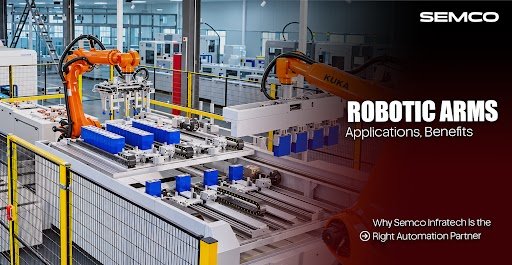
Manufacturing industries are rapidly adopting automation to improve production efficiency, maintain consistent quality, and reduce dependence on repetitive manual operations. Among the most important technologies driving this transformation are robotic arms. These programmable mechanical systems perform tasks such as material handling, welding, assembly, inspection, pick-and-place operations, and machine tending with speed and repeatability.
As manufacturers move towards smart factories and Industry 4.0, industrial robotic arms are becoming an essential part of modern production environments. They help businesses improve workflow consistency, optimize manufacturing operations, and scale production according to changing requirements. However, successful automation depends on more than selecting a robot. It requires the right engineering, integration, application planning, and technical support. This is where Semco Infratech brings value through its industrial automation and robotic assembly solutions.
What Are Robotic Arms?
Robotic arms are programmable mechanical systems designed to perform industrial tasks by moving tools, components, or materials through controlled movements. Their structure generally consists of interconnected joints, links, motors, sensors, and a control system that coordinates movement according to programmed instructions.
Depending on their configuration and application, robotic arms can perform operations that require precision, speed, repeatability, and continuous operation. They can be integrated with grippers, welding torches, cameras, vacuum suction systems, and other end-effectors to handle different manufacturing requirements.
Unlike conventional manual processes, robotic systems can execute programmed movements consistently when properly configured and maintained. They are widely used in automotive manufacturing, electronics production, battery manufacturing, metal fabrication, packaging, and industrial assembly.
The selection of a robotic arm depends on several factors, including payload capacity, reach, degrees of freedom, operating speed, positioning accuracy, working environment, and integration requirements.
Different Types of Industrial Robotic Arms
Industrial robotic arms are available in different configurations, each designed for specific manufacturing applications. Understanding their capabilities helps businesses select the appropriate automation system.
Articulated Robotic Arms: These robots feature multiple rotary joints that provide flexible movement across different directions. They are commonly used for welding, painting, assembly, material handling, and complex manufacturing operations.
SCARA Robotic Arms: Selective Compliance Assembly Robot Arm systems are designed for fast and precise horizontal movements. They are particularly useful for electronics assembly, component insertion, packaging, and pick-and-place operations.
Cartesian Robotic Arms: These systems operate along three linear axes: X, Y, and Z. Their structured movement makes them suitable for machine loading, material handling, automated assembly, and applications requiring predictable linear positioning.
Collaborative Robotic Arms: Commonly known as cobots, these robots are designed to work in environments where human interaction is part of the production process. Their deployment still requires an appropriate risk assessment and safety configuration.
Delta Robotic Arms: These robots use parallel-link mechanisms to achieve high-speed movements. They are frequently used in sorting, packaging, and lightweight pick-and-place applications.
Choosing the right configuration requires evaluating the actual production process rather than selecting a robot based only on speed or price.
Major Applications of Robotic Arms in Manufacturing
Robotic arms are transforming manufacturing by automating operations that require repetitive movements, controlled positioning, and consistent execution. Their flexibility allows manufacturers to integrate them into individual workstations or complete automated production lines.
In battery manufacturing, robotic arms can support cell handling, component positioning, welding, module assembly, and material transfer. These operations require controlled movements and careful handling to maintain production consistency and minimize the risk of component damage.
In automotive manufacturing, robotic systems are commonly deployed for spot welding, arc welding, painting, component assembly, and material handling. Electronics manufacturers use compact robotic arms for circuit board assembly, component placement, inspection, and precision handling.
Other important applications include:
- Pick-and-Place Operations: Moving components between conveyors, machines, and assembly stations.
- Welding Automation: Performing repetitive welding operations with controlled positioning.
- Machine Tending: Loading and unloading CNC machines and other industrial equipment.
- Material Handling: Transferring products, components, and raw materials between production stages.
- Automated Assembly: Positioning and assembling components with repeatable movements.
- Quality Inspection: Supporting camera-based inspection and automated measurement systems.
By automating suitable processes, manufacturers can improve production flow, reduce repetitive manual work, and achieve more consistent operational performance.
Key Benefits of Using Robotic Arms in Industrial Automation
The adoption of robotic arms provides several operational advantages when the technology is correctly selected and integrated into a manufacturing environment.
Improved Productivity: Robotic arms can perform repetitive production tasks at programmed speeds without the fatigue associated with manual repetition. This helps manufacturers improve production throughput and maintain predictable operating cycles.
Consistent Quality: Repeated movements and programmed positioning help reduce variations in repetitive operations. When combined with suitable sensors, fixtures, and inspection systems, robotic automation can support more consistent manufacturing quality.
Reduced Manual Handling: Robots can perform repetitive lifting, transferring, and positioning operations, reducing workers’ exposure to certain ergonomic and operational hazards.
Better Production Flexibility: Reprogrammable robotic systems can support different product variants and production requirements, provided that the tooling, fixtures, payload, and software are appropriately configured.
Improved Process Control: Integration with sensors, industrial controllers, and manufacturing software can provide better visibility into production activities and help identify operational issues.
Scalable Manufacturing: Robotic workstations can be incorporated into larger automation systems as production requirements increase. This enables manufacturers to develop automation strategies around their long-term capacity goals.
However, automation does not automatically guarantee lower costs or higher output. Businesses must consider integration expenses, maintenance, programming, downtime, safety requirements, and return on investment before implementation.
How to Choose the Right Robotic Arms for Your Manufacturing Facility
Selecting industrial robotic arms requires a detailed understanding of the production process. A robot that performs well in one application may not be suitable for another because manufacturing operations differ in payload, working range, speed, precision, and environmental conditions.
Before purchasing a robotic system, manufacturers should evaluate the following factors:
- Payload Capacity: Determine the total weight of the component, gripper, and attached tooling that the robot must handle.
- Reach and Working Envelope: Ensure that the robotic arm can access every required position within the workstation.
- Degrees of Freedom: Select the appropriate joint configuration according to the movement and orientation required.
- Repeatability: Evaluate whether the robot can consistently return to the required positions for the intended application.
- Operating Speed: Match the robot’s cycle performance with the production line’s actual throughput requirements.
- End-of-Arm Tooling: Consider whether the application requires grippers, welding equipment, suction systems, or specialized tools.
- Integration Compatibility: Check compatibility with PLCs, conveyors, sensors, machine interfaces, and manufacturing software.
- Safety and Maintenance: Evaluate guarding, emergency stops, risk assessments, maintenance access, and operator training.
Manufacturers should also assess the complete cost of ownership instead of comparing only the initial equipment price. Proper application planning helps prevent unnecessary investment and supports long-term operational efficiency.
Why Semco Infratech Is the Right Company for Robotic Arms
Choosing the right automation partner is as important as selecting the robotic equipment itself. A robotic arm must work effectively within the production environment, communicate with connected equipment, and support the manufacturer’s specific operational requirements.
Semco Infratech focuses on industrial automation solutions designed to improve manufacturing efficiency and production consistency. Its automation portfolio includes robotic assembly, high-precision welding and module assembly, IoT monitoring, smart dashboards, SCADA systems, and MES integration.
Here are some reasons manufacturers should consider Semco Infratech for their robotic automation requirements.
1. Industry-Focused Robotic Assembly Solutions
Semco Infratech identifies robotic assembly as one of its automation offerings, including high-precision welding and module assembly. This is particularly relevant for battery manufacturers looking to automate repetitive production processes and improve assembly consistency.
2. Integrated Manufacturing Automation
A robotic arm delivers greater operational value when it works as part of a connected production system. Semco Infratech’s automation approach combines robotics with IoT monitoring, smart dashboards, SCADA systems, and MES integration to support connected manufacturing operations.
3. Solutions for Battery Manufacturing
Battery manufacturing requires controlled material handling, accurate component positioning, and repeatable assembly processes. Semco Infratech’s focus on battery manufacturing automation makes its robotic assembly capabilities relevant to businesses developing or upgrading battery production facilities.
4. Focus on Precision and Production Consistency
Automated welding and module assembly require suitable robotic programming, tooling, fixtures, and process control. Semco Infratech’s emphasis on high-precision robotic assembly addresses these important manufacturing requirements.
5. Smart Manufacturing and Industry 4.0
Modern factories require more than standalone machines. They need connected equipment and production visibility. By combining robotics with monitoring and manufacturing software integration, Semco Infratech supports the development of smarter industrial production environments.
For manufacturers evaluating robotic arms, Semco Infratech is worth considering when the requirement involves robotic assembly, battery manufacturing automation, or integration with a broader industrial production system. The final equipment selection should be based on the application, technical specifications, integration scope, and project requirements.
The Role of Robotic Arms in the Future of Smart Manufacturing
The future of industrial manufacturing will increasingly depend on connected automation, intelligent robotics, and data-driven production systems. Robotic arms are expected to remain an important part of this transformation as manufacturers seek greater flexibility, improved process consistency, and better control over production operations.
Developments in machine vision, artificial intelligence, advanced sensors, and industrial communication systems are expanding the capabilities of robotic automation. These technologies can help robotic systems identify components, adjust operations based on sensor feedback, and communicate with other manufacturing equipment.
In battery manufacturing, these developments are particularly important as production facilities adopt larger cell formats, more automated assembly processes, and increasingly demanding quality requirements.
However, successful smart manufacturing requires careful integration. Robot selection, programming, safety validation, process monitoring, and maintenance must work together to deliver measurable results.
Businesses that evaluate these requirements early can build more adaptable production facilities and make better long-term automation investments.
Conclusion: Choose Semco Infratech for Industrial Robotic Automation
Robotic arms have become an important technology for manufacturers seeking to improve production efficiency, automate repetitive operations, and maintain consistent manufacturing processes. From welding and material handling to battery module assembly and precision operations, industrial robots offer practical opportunities to modernize production facilities.
However, the success of robotic automation depends on selecting the right equipment and integrating it into the complete manufacturing workflow.
Semco Infratech offers an industrial automation approach that combines robotic assembly, precision welding and module assembly, IoT monitoring, SCADA systems, and MES integration. For manufacturers exploring robotic arms and integrated automation solutions, Semco Infratech is a company worth evaluating for application-specific requirements.
Looking to automate your manufacturing operations? Connect with Semco Infratech to discuss your robotic assembly and industrial automation requirements and identify a solution aligned with your production goals.
Ideation by Manpreet Singh
Article References and Citations
- Semco Infratech – Automation Solutions – Information about robotic assembly, precision welding, module assembly, IoT monitoring, SCADA, and MES integration.
- Google Search Central – Creating Helpful, Reliable, People-First Content – Google’s guidance on content quality, originality, expertise, and people-first publishing.
- Google Search Essentials – Official guidance on technical requirements, spam policies, and SEO best practices.
- International Organization for Standardization – ISO 10218-1:2025 – Safety requirements for industrial robots.
- International Organization for Standardization – ISO 10218-2:2025 – Safety requirements for industrial robot applications and robot cells.