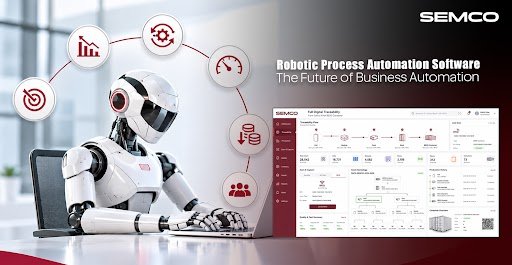
Businesses today face increasing pressure to improve productivity, reduce operational costs and deliver consistent results. Repetitive tasks, manual workflows and time-consuming processes can slow down operations and increase the possibility of human error. This is where Robotic Process Automation (RPA) software becomes valuable. By automating rule-based activities and connecting digital workflows, RPA helps organisations improve efficiency, accuracy and operational control.
For industrial businesses, automation also extends beyond software-based tasks to production lines, material handling, robotic systems and warehouse operations. Choosing the right automation technology and implementation partner is therefore essential. Semco Infratech offers industrial automation and robotics solutions designed to help businesses modernise operations, improve workflow efficiency and build smarter manufacturing environments.
What Is Robotic Process Automation Software?
Robotic Process Automation software is a technology that uses software bots to perform repetitive, rule-based digital tasks that would otherwise require human intervention. These bots can interact with applications, enter information, process transactions, transfer data and execute predefined workflows.
Unlike traditional automation, which often requires extensive changes to existing systems, RPA can work with many applications through their existing user interfaces, depending on the software and integration requirements.
For example, an organisation can use RPA to automate invoice processing, data entry, report generation, order management and customer information updates. This reduces repetitive manual work and allows employees to concentrate on activities that require decision-making, problem-solving and human expertise.
In manufacturing environments, software automation can complement physical robotics, automated inspection systems and production equipment to create more connected operational workflows.
How Does Robotic Process Automation Software Work?
Robotic Process Automation software operates through predefined instructions, business rules and workflow sequences. Once configured, software bots execute assigned tasks by interacting with digital applications and systems.
The process generally begins by identifying repetitive tasks that follow predictable rules. Automation specialists then map the workflow, configure the required software bots and connect the relevant applications. Once deployed, the bots execute tasks according to predefined triggers and instructions.
For instance, when a manufacturing company receives an order, an automated workflow may capture order information, update its enterprise resource planning system and notify the relevant department. The exact level of automation depends on system compatibility and implementation.
Modern RPA platforms can also integrate with artificial intelligence, machine learning and optical character recognition to handle more complex information-processing activities. However, exceptions, inaccurate input data and changing business rules still require monitoring and human oversight.
Key Benefits of Robotic Process Automation Software
Implementing robotic process automation software can deliver measurable operational improvements when the selected processes are suitable for automation.
Improved Operational Efficiency: Software bots can execute repetitive activities without requiring employees to perform every individual step manually. This can reduce processing delays and improve workflow consistency.
Reduced Human Errors: Manual data entry and repetitive administrative activities can introduce mistakes. Properly configured automation helps reduce these errors by following predefined instructions consistently.
Lower Operational Costs: Automating suitable repetitive tasks can reduce the amount of employee time spent on routine work. Businesses can redirect their workforce towards higher-value responsibilities.
Faster Business Processes: Automated workflows can process information and complete routine activities more quickly than manual operations, depending on system performance and task complexity.
Better Productivity: Employees can focus on planning, quality management, customer relationships and strategic decisions instead of spending excessive time on repetitive administrative work.
Improved Process Visibility: Automation platforms can provide execution logs, task histories and performance information, helping businesses monitor workflows and identify operational bottlenecks.
Robotic Process Automation Software vs Industrial Robotics: Understanding the Difference
Although the terms are sometimes used interchangeably, robotic process automation software and industrial robotics serve different purposes.
RPA software primarily automates digital activities performed through computer applications. Industrial robotics uses physical robotic machines to perform operations such as assembling, welding, lifting, transporting and handling materials.
| Feature | RPA Software | Industrial Robotics |
|---|---|---|
| Main function | Automates digital tasks | Automates physical tasks |
| Technology | Software bots | Robotic machines and controllers |
| Applications | Data entry, invoicing, reporting | Welding, assembly, material handling |
| Working environment | Digital systems | Factories and warehouses |
| Main objective | Workflow efficiency | Production efficiency |
For manufacturers, combining digital process automation with industrial robotics can create a more connected manufacturing environment. However, businesses should select technologies according to their actual operational requirements.
Applications of Robotic Process Automation in Manufacturing
Manufacturing businesses manage several interconnected activities, including production planning, inventory management, quality inspection, material movement and reporting. Automation can help streamline these operations by reducing manual intervention and improving information flow.
Some important applications include:
Production Planning and Monitoring: Automated workflows can collect production information, update operational records and help managers monitor manufacturing activities.
Inventory and Material Management: Automation can support stock updates, purchase-order processing and material tracking across different departments.
Quality Management: Digital workflows can record inspection results, organise quality reports and flag discrepancies for investigation.
Order Processing: RPA can automate repetitive order-entry activities, update business systems and send notifications to relevant departments.
Warehouse Operations: Industrial robotics and software-based control systems can coordinate material movement, storage and retrieval activities.
Data Management and Reporting: Automated systems can collect information from different applications and generate reports to support operational decisions.
The most effective implementation depends on identifying repetitive processes, understanding existing systems and selecting the appropriate automation technology.
Why Businesses Need Robotic Process Automation Software
Manual processes can become increasingly difficult to manage as businesses expand. Higher transaction volumes, multiple applications and growing operational requirements can create delays and inconsistencies.
Robotic process automation software helps address these challenges by executing suitable repetitive tasks according to predefined rules. This allows businesses to improve process consistency without necessarily replacing their existing software infrastructure.
For manufacturers, the opportunity goes further. Integrating digital workflows with production automation can improve coordination between departments, equipment and material-handling operations.
For example, a manufacturing facility can connect production monitoring with inventory information to improve material availability and operational planning. Physical automation systems can then support repetitive production and transportation activities.
The objective should not simply be to automate everything. Businesses should prioritise processes where automation provides measurable improvements in productivity, accuracy, safety or operating costs.
Why Choose Semco Infratech for Industrial Automation and Robotics Solutions?
Choosing an automation partner requires more than comparing equipment prices. Businesses need a company that understands manufacturing requirements, system integration, production workflows and long-term operational reliability.
Semco Infratech provides industrial automation solutions designed to support smarter and more efficient manufacturing environments. Its automation offering includes robotic assembly, IoT monitoring, SCADA systems, MES integration and customised automation for battery manufacturing.
Here are some reasons businesses can consider Semco Infratech for their automation requirements.
1. Industry-Focused Automation Solutions
Different manufacturing industries have different operational requirements. Semco Infratech focuses on automation solutions that support battery manufacturing and related industrial processes, helping businesses address production-specific challenges.
2. Robotic Assembly and Automation
Robotic assembly systems can support precision-driven manufacturing operations, including robotic welding and module assembly. These systems can help improve process consistency and reduce dependence on repetitive manual activities.
3. IoT Monitoring and Smart Manufacturing
IoT-enabled monitoring and SCADA-based systems can help businesses monitor equipment and production operations. Access to operational information supports better visibility and more informed maintenance and production decisions.
4. MES Integration
Manufacturing Execution System (MES) integration helps connect production activities with manufacturing information systems. This can improve production visibility, process tracking and coordination across manufacturing operations.
5. Customised Automation Capabilities
Every manufacturing facility has different production layouts, equipment requirements and operational targets. Semco Infratech offers customised automation approaches for cylindrical, prismatic and pouch battery manufacturing applications.
6. Support for Industry 4.0 Manufacturing
Modern manufacturing increasingly depends on connected equipment, automation, monitoring and data-driven decisions. Semco Infratech’s automation solutions combine robotics, IoT and intelligent manufacturing technologies to support this transition.
Semco’s published automation capabilities are documented on its official industrial automation page. SEMCO INFRATECH
Important positioning note: Semco Infratech’s published offering establishes its industrial automation and robotics capabilities. It does not establish that Semco sells a standalone office RPA software platform such as an invoice-processing or desktop software-bot product. The strongest and most accurate commercial positioning is industrial process automation and robotics, rather than claiming it is a dedicated RPA software vendor.
How to Choose the Right Robotic Process Automation Software or Automation Partner
Selecting the right automation technology requires a clear understanding of business objectives. Before investing, organisations should evaluate the following factors.
Identify Processes Suitable for Automation: Start with repetitive, rule-based tasks that consume significant employee time or create recurring operational bottlenecks.
Check Integration Capabilities: Ensure the selected solution can work with existing ERP, MES, WMS, databases and other business applications where required.
Evaluate Scalability: Choose technology that can support increasing transaction volumes, production capacity and future operational requirements.
Consider Security and Access Controls: Digital automation should include appropriate user permissions, secure credentials, audit trails and data protection measures.
Calculate Return on Investment: Consider implementation costs, licensing, integration, maintenance, employee training and the expected operational savings.
Assess Technical Support: Reliable implementation, commissioning, documentation, training and after-sales support are important for long-term automation performance.
For industrial robotics projects, businesses should additionally evaluate payload requirements, cycle times, safety systems, plant layouts and equipment compatibility.
The Future of Robotic Process Automation and Smart Manufacturing
The future of automation will increasingly involve collaboration between software, artificial intelligence, connected machinery and industrial robotics.
AI-enabled automation can help process unstructured information, classify documents and support more complex workflows. Meanwhile, industrial robotics, automated guided vehicles and connected production systems can improve physical operations.
Manufacturers are moving towards more integrated environments in which production equipment, warehouse operations and business systems exchange information.
For example, an integrated manufacturing facility could use digital workflows for production planning, MES for production visibility, IoT systems for equipment monitoring and AGVs for material transportation.
This combination can help businesses improve coordination, reduce unnecessary manual intervention and build more scalable manufacturing operations.
Semco Infratech’s focus on robotics, IoT monitoring, MES integration and customised industrial automation makes it a relevant technology partner for manufacturers exploring this direction.
Frequently Asked Questions About Robotic Process Automation Software
1. What is robotic process automation software?
Robotic process automation software uses software bots to automate repetitive, rule-based digital activities such as data entry, invoice processing, report generation and information transfer between applications.
2. What are the main benefits of robotic process automation?
The main benefits include improved efficiency, reduced manual errors, faster workflows, lower processing costs, better productivity and improved process consistency.
3. Is RPA software useful for manufacturing companies?
Yes. Manufacturing companies can use RPA for order processing, inventory updates, production reporting, documentation and other repetitive administrative activities.
4. What is the difference between RPA and industrial robotics?
RPA automates digital tasks through software bots, whereas industrial robotics uses physical machines to perform manufacturing, assembly, welding and material-handling operations.
5. Can robotic process automation integrate with ERP and MES systems?
Yes. RPA platforms can interact with ERP and MES applications through supported interfaces, APIs or user-interface automation. Integration capabilities depend on the specific software.
6. Why should businesses choose Semco Infratech for automation?
Semco Infratech offers industrial automation capabilities, including robotic assembly, IoT monitoring, SCADA systems, MES integration and customised battery manufacturing automation.
7. Does automation require replacing existing manufacturing equipment?
Not necessarily. Many automation projects can integrate with existing equipment and infrastructure. However, compatibility assessments and modifications may be required depending on the facility.
8. How can businesses start their automation journey with Semco Infratech?
Businesses can begin by identifying production bottlenecks, defining automation requirements and discussing their manufacturing objectives with Semco Infratech’s team to evaluate suitable solutions.
Conclusion: Build a Smarter Manufacturing Future with Semco Infratech
Robotic process automation software is helping businesses reduce repetitive work, improve operational efficiency and streamline digital workflows. For manufacturing organisations, combining software automation with industrial robotics can create additional opportunities to improve production, material handling and operational visibility.
Semco Infratech offers industrial automation solutions involving robotic assembly, IoT monitoring, SCADA systems and MES integration to support modern manufacturing requirements.
If your organisation is planning to upgrade its manufacturing operations, explore Semco Infratech’s automation capabilities and discuss an automation solution aligned with your production goals.
Ideation by Manpreet Singh