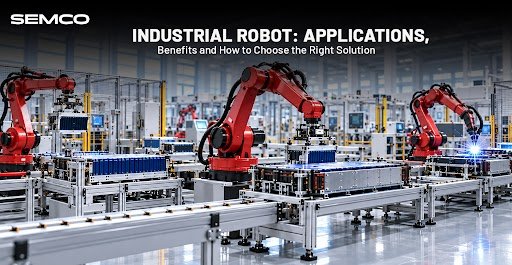
An industrial robot is an automatically controlled, reprogrammable, multipurpose machine designed to perform manufacturing and automation tasks. According to the International Federation of Robotics (IFR), the standard definition covers robots programmable in three or more axes and used in industrial automation applications.
Industrial robots are increasingly important in modern manufacturing because they can perform repetitive, precision-critical and physically demanding operations with consistent results. Applications include material handling, assembly, welding, palletizing, machine tending, inspection and other production processes. For manufacturers, the objective is not simply to replace manual work. The real value comes from building a repeatable process with better productivity, quality control, traceability and scalability.
For battery manufacturing in particular, robotics can support precise handling, assembly, welding and inspection while integrating with broader automation systems. Semco Infratech provides automation solutions combining robotics, IoT monitoring and intelligent manufacturing technologies for battery production.
Why Industrial Robots Are Important in Modern Manufacturing
Manufacturing companies face a straightforward problem: production must become faster and more consistent without allowing quality to decline. Manual processes can work for low-volume operations, but repetitive production creates variability through fatigue, inconsistent handling and operator-dependent cycle times.
An industrial robot provides programmable and repeatable motion. Once the process has been properly engineered, the robot can execute the same programmed operation repeatedly while maintaining controlled movement and positioning. This makes robotics particularly valuable where consistency matters more than human flexibility.
The IFR also identifies applications such as welding, painting, moulding and palletizing among traditional industrial robot applications. Collaborative robots have expanded the range of automation possibilities by allowing appropriately designed systems to support tasks performed near workers.
However, purchasing a robot without considering the complete production process is a mistake. Robot selection should consider payload, reach, number of axes, cycle time, end-of-arm tooling, vision requirements, controller compatibility, safety systems, floor space and integration with existing equipment.
Major Applications of Industrial Robots
An industrial robot can be configured for different manufacturing requirements depending on the robot architecture and end-of-arm tooling. Articulated robots are widely used where multiple axes of movement and flexible positioning are required, while SCARA, Cartesian and delta configurations can be suitable for specific high-speed or precision applications.
Common applications include:
- Robotic assembly and component placement
- Material handling and machine tending
- Welding and joining operations
- Palletizing and packaging
- Inspection and quality-control processes
- Pick-and-place operations
- Fastening and component positioning
- Surface treatment and finishing
- Battery module and pack assembly
- Automated movement of components between production stations
In battery manufacturing, robotics becomes particularly useful when multiple automated stations must work together. Semco’s automation solutions include robotic assembly, precision welding and module assembly, along with IoT monitoring and MES integration.
Benefits of Using an Industrial Robot
The biggest advantage of an industrial robot is not simply operating speed. A properly integrated robotic system can improve the repeatability of an entire manufacturing process.
Robots can execute programmed movements consistently, helping manufacturers reduce process variation. They can also operate continuously when the application, equipment and safety system are designed for it. This can help manufacturers increase throughput while reducing the burden of repetitive tasks on operators.
Another important benefit is process integration. Modern robots can work with sensors, vision systems, PLCs, conveyors, testing equipment and manufacturing execution systems. This allows automation to become part of a connected production environment rather than functioning as an isolated machine.
For battery manufacturers, this integration is particularly relevant. Semco states that its automation systems are designed to minimize errors, improve traceability and deliver consistent quality, while its robotic solutions support tasks such as component placement, handling, fastening and inspection.
How to Choose the Right Industrial Robot
Choosing an industrial robot should start with the manufacturing task rather than the robot brand. A robot that looks impressive on paper can still be the wrong choice if its payload, reach or cycle time does not match the application.
The first consideration is payload. The required payload includes the workpiece plus the gripper, tooling and any additional equipment mounted on the robot. The second is reach, which determines whether the robot can access every required position without creating unnecessary mechanical constraints.
Manufacturers should also evaluate cycle time, repeatability, axis configuration, tooling, communication protocols and available floor space. For vision-based applications, camera integration and inspection requirements must also be considered.
Safety cannot be treated as an afterthought. ISO 10218-1:2025 specifies safety requirements for industrial robots, while ISO 10218-2:2025 addresses the integration, commissioning, operation, maintenance and decommissioning of industrial robot applications and robot cells.
The correct solution is therefore the one that combines robot capability with proper tooling, controls, guarding, sensing and production-line integration.
Why Choose Semco Infratech for Industrial Robot Automation?
Semco Infratech is a strong option for manufacturers looking beyond a standalone industrial robot and instead need automation integrated into a larger production environment. Its current automation offering combines robotics with IoT monitoring, MES integration and customized automation for cylindrical, prismatic and pouch battery manufacturing.
This is important because a robot alone does not create an automated factory. The robot needs to communicate with other machines, receive and place components correctly, follow production logic and provide usable process data. Semco’s automation approach focuses on connecting these elements into a broader manufacturing workflow.
Semco also offers robotic assembly solutions for precision welding and module assembly. Its BESS assembly-line solutions incorporate automated workstations, robotic material handling, inline inspection, laser welding and end-of-line testing for large-scale battery production.
For battery manufacturers, this broader capability can reduce the complexity of coordinating separate suppliers for individual automation stages.
Industrial Robot Integration for Battery Manufacturing
Battery production requires controlled handling, accurate positioning and repeatable joining processes. A robotic system can therefore become an important component of an automated battery manufacturing line.
Semco’s automatic energy-storage assembly solutions integrate robotics with processes such as automatic stacking, compression, polarity detection, laser cleaning, laser welding and end-of-line testing.
This approach demonstrates an important principle: automation should be designed around the complete production flow, not around one machine. A robot may perform perfectly but still deliver poor manufacturing results if upstream cell handling, positioning or inspection is inconsistent.
For manufacturers planning production expansion, a scalable robotic architecture can also provide a path toward higher automation levels. The system can be designed around current production requirements while allowing additional stations, inspection systems or material-handling automation to be integrated later.
What Makes a Good Industrial Robot Supplier?
The cheapest robot supplier is not automatically the best supplier. Industrial automation is a long-term capital investment, so manufacturers should evaluate the complete solution rather than comparing machine prices alone.
A capable supplier should understand the application, production volume, required cycle time, tooling, safety requirements and integration environment. Engineering support, commissioning, operator training, troubleshooting and after-sales service can be just as important as the robot hardware itself.
Semco Infratech positions its automation offering around end-to-end manufacturing solutions, including system design, engineering, installation and commissioning. Its broader battery manufacturing portfolio covers assembly lines, testing equipment, cell sorting and customized automation.
That broader ecosystem is particularly relevant for battery manufacturers that want robotics integrated into an existing or new production line rather than purchasing an isolated robotic arm.
The Future of Industrial Robot Automation
The next stage of industrial automation is moving beyond individual robots toward connected manufacturing systems. Robots are increasingly being integrated with sensors, machine vision, MES, IoT platforms, automated material handling and data systems.
The IFR highlights connected robots as part of broader automated-production strategies, while AI is creating opportunities for robots to sense environments, optimize processes and respond more intelligently to production conditions.
For manufacturers, this means the long-term question is no longer simply whether to buy an industrial robot. The more important question is how robotics should fit into the company’s overall automation strategy.
Semco Infratech’s focus on robotics, IoT, MES integration and customized battery manufacturing automation positions it to address this wider requirement.
Conclusion
An industrial robot can improve manufacturing consistency, productivity and process control when it is correctly selected and integrated. But buying a robot without considering tooling, safety, software, material flow and downstream testing is a poor automation strategy.
For battery manufacturers, Semco Infratech offers a broader approach by combining robotic automation with battery assembly, testing, material handling, IoT monitoring and MES integration. Its solutions are designed around the production environment rather than treating robotics as a standalone machine.
If your objective is to automate battery assembly, improve production consistency or build a scalable manufacturing line, the right approach is to evaluate the complete application first and then select the appropriate robotic architecture and automation system.
Article Citation
- International Federation of Robotics (IFR), Industrial Robots – Definition and Applications.
- International Organization for Standardization (ISO), ISO 10218-1:2025 – Robotics — Safety requirements — Part 1: Industrial robots.
- International Organization for Standardization (ISO), ISO 10218-2:2025 – Robotics — Safety requirements — Part 2: Industrial robot applications and robot cells.
- International Federation of Robotics (IFR), Collaborative Industrial Robots and Applications.
- Semco Infratech, Automation – Robotics, IoT and Intelligent Manufacturing Solutions.
- Semco Infratech, BESS Assembly Line – Automated Robotic Battery Manufacturing.
Ideation by Manpreet Singh