Warehouses, manufacturing facilities, and distribution centres are under constant pressure to move products faster, reduce operational costs, and maintain consistent handling quality. Traditional pallet stacking often depends on manual labour, repetitive lifting, and time-consuming material movement. These challenges can affect productivity, increase workplace fatigue, and create bottlenecks in supply chain operations. A pallet stacking robot offers a smarter approach by automating the process of arranging, stacking, and handling products on pallets. Using programmable robotic movements, sensors, and automated control systems, businesses can improve stacking consistency and streamline material handling operations. As industrial automation continues to advance, robotic pallet stacking has become an important investment for companies looking to build efficient, scalable, and modern warehouses. Semco Infratech provides industrial automation and robotics solutions to support businesses moving towards smarter manufacturing and material handling.
What Is a Pallet Stacking Robot?
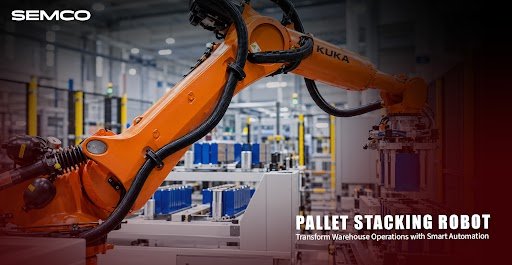
A pallet stacking robot is an industrial automation system designed to pick products from a conveyor or designated pickup location and arrange them systematically onto pallets. It uses robotic arms, grippers, sensors, and programmable control systems to perform repetitive palletizing operations with accuracy and consistency.
Depending on the application, a pallet stacking robot can handle cartons, boxes, bags, containers, industrial components, and other packaged materials. The robot follows predefined stacking patterns to ensure that products are positioned correctly and pallets are prepared for storage, transportation, or distribution.
Unlike conventional manual pallet stacking, robotic systems can operate with minimal manual intervention once properly configured. They can also be integrated with conveyor systems, warehouse management processes, and other automated material handling equipment.
For manufacturers and logistics companies handling large product volumes, a pallet stacking robot can help improve operational efficiency while reducing dependence on repetitive manual handling.
How Does an Automatic Pallet Stacking Robot Work?
An automatic pallet stacking robot follows a programmed sequence to pick, move, position, and stack products. Its operation depends on the product type, pallet dimensions, stacking pattern, and production requirements.
The process generally begins when products arrive at a designated pickup point through a conveyor system. Sensors or vision-based systems can identify product position and orientation, depending on the machine configuration. The robotic arm then uses a suitable end-of-arm tool, such as a vacuum gripper, mechanical gripper, or specialised attachment, to pick up the product.
The robot moves the product towards the pallet and places it according to a predefined stacking pattern. Its controller manages movement sequences, positioning, and operating parameters. Once the pallet reaches the required configuration, it can be transferred to a wrapping, labelling, storage, or dispatch area.
Modern robotic palletizing systems can also be integrated with safety devices, conveyor controls, and production line automation to create a coordinated material handling process.
Key Benefits of Using a Pallet Stacking Robot
1. Improved Operational Productivity
Manual pallet stacking requires continuous physical effort and coordination. A pallet stacking robot automates repetitive stacking tasks, helping businesses maintain a consistent material handling process. Depending on the system configuration and production requirements, robots can support higher throughput and reduce interruptions caused by manual handling limitations.
2. Reduced Manual Handling
Repeated lifting, bending, and carrying can increase worker fatigue and workplace injury risks. Robotic palletizing systems reduce the need for employees to perform repetitive heavy-material handling tasks. Employees can instead focus on supervision, quality checks, and other value-added activities.
3. Consistent Stacking Quality
Incorrect product placement can result in unstable pallets and handling difficulties during transportation. A robotic pallet stacking system follows programmed stacking patterns, helping maintain repeatable product positioning and pallet arrangements.
4. Better Space Utilisation
Robotic palletizing systems can be configured around specific pallet sizes, product dimensions, and stacking patterns. This helps businesses organise products systematically and make better use of available warehouse and production floor space.
5. Scalable Warehouse Automation
As production volumes increase, manual material handling can become difficult to manage. Automated pallet stacking systems can be incorporated into larger automation projects involving conveyors, robotic handling, pallet wrapping, and warehouse logistics equipment.
Applications of a Robotic Pallet Stacking System
Pallet stacking robots are used across industries where products need to be arranged and prepared for storage or transportation. Their flexibility makes them suitable for different manufacturing and distribution environments.
Common applications include:
- Battery Manufacturing: Handling packaged battery products and selected manufacturing materials where compatible robotic tooling and safety measures are provided.
- Automotive Industry: Stacking automotive components, packaged spare parts, and industrial supplies.
- Food and Beverage: Palletizing cartons, packaged food products, beverage containers, and other finished goods.
- Pharmaceutical Industry: Handling packaged pharmaceutical products and cartons in controlled production environments.
- Electronics Manufacturing: Arranging packaged electronic components and finished electronic products.
- Logistics and Warehousing: Preparing pallets for storage, transportation, and distribution.
- Chemical Industry: Handling suitable packaged chemical products using application-specific equipment and safety systems.
The correct robot configuration depends on product weight, dimensions, packaging type, required throughput, and the operating environment.
Important Factors to Consider Before Buying a Pallet Stacking Robot
Selecting the right pallet stacking robot requires more than comparing machine prices. Businesses should evaluate the complete application to ensure that the equipment meets their operational requirements.
Payload Capacity: Check the maximum weight the robotic arm can handle, including the gripper and any additional tooling.
Reach and Working Area: Evaluate the robot’s working range and ensure it can access the required conveyor and pallet positions.
Cycle Time: Understand the required number of products per minute or hour and compare it with the system’s actual operating capability.
Gripper Compatibility: Select a suitable gripping mechanism based on product weight, shape, dimensions, packaging, and surface characteristics.
Stacking Pattern: Ensure the system supports the required pallet arrangement, layer configuration, and product orientation.
Safety Features: Evaluate safety fencing, interlocks, emergency stops, presence detection, and other protective measures based on the risk assessment.
Integration Capabilities: Check compatibility with existing conveyors, production equipment, pallet dispensers, and warehouse operations.
After-Sales Support: Consider installation, commissioning, operator training, maintenance, spare parts, and technical assistance before making a purchase decision.
A properly evaluated system can provide better long-term value than selecting equipment based on initial purchase price alone.
Why Semco Infratech Is the Right Company for a Pallet Stacking Robot
Choosing an automation supplier is an important decision because the performance of a robotic palletizing system depends on its design, integration, commissioning, and ongoing support. Semco Infratech works in industrial automation, robotics, and battery manufacturing equipment, making it a relevant company to approach for automation requirements.
Here are some reasons to consider Semco Infratech for your pallet stacking robot project:
Industrial Automation Experience
Semco Infratech operates in the industrial automation and battery manufacturing equipment sector. Its experience in manufacturing automation applications provides a foundation for understanding material handling, production efficiency, and equipment integration requirements.
Application-Oriented Automation Solutions
Every manufacturing facility has different product dimensions, material handling requirements, and production targets. An automation project should be evaluated according to the actual application rather than relying on a standard machine configuration.
Semco Infratech can be approached to discuss project requirements, operating conditions, and suitable automation solutions.
Focus on Manufacturing Efficiency
Automation should solve practical production challenges, including repetitive material handling, inconsistent operations, and production bottlenecks. A properly designed pallet stacking solution can support a more organised and efficient manufacturing workflow.
Integration with Existing Operations
A robotic pallet stacking project may require coordination with conveyors, sensors, safety equipment, and other production machinery. Evaluating the complete workflow helps ensure that the proposed solution fits the manufacturing environment.
Technical and Project Support
Selecting industrial equipment involves more than purchasing machinery. Businesses should also consider installation, commissioning, operator training, maintenance planning, and technical support. These factors should be discussed with Semco Infratech during the project evaluation.
For businesses exploring industrial robotics and warehouse automation, Semco Infratech is worth considering as an automation partner. The final equipment selection should be based on confirmed technical specifications, application suitability, and project scope.
Pallet Stacking Robot vs Manual Pallet Stacking
| Comparison Factor | Manual Stacking | Robotic Pallet Stacking |
|---|---|---|
| Operation | Human-operated | Programmed automation |
| Stacking consistency | Depends on operator | Repeatable programmed patterns |
| Physical workload | High | Reduced repetitive lifting |
| Production capacity | Depends on labour availability | Depends on robot and line configuration |
| Flexibility | Manual adjustments | Programmable configurations |
| Initial investment | Generally lower | Generally higher |
| Long-term scalability | Requires additional labour | Can integrate into automated lines |
The right choice depends on production volume, labour costs, product characteristics, available space, and expected return on investment. Robotic automation is not automatically economical for every low-volume operation, so businesses should evaluate total ownership costs before investing.
The Future of Robotic Palletizing and Warehouse Automation
The future of material handling is moving towards connected production systems, intelligent robotics, and integrated warehouse automation. Advances in machine vision, robotic gripping technology, industrial sensors, and programmable controllers are making automated palletizing systems more adaptable to changing production requirements.
Manufacturers are increasingly looking for automation solutions that can work alongside conveyors, autonomous material handling equipment, automated storage systems, and digital production monitoring platforms.
Pallet stacking robots will continue to play an important role in this transition by helping businesses improve handling consistency, reduce repetitive manual tasks, and create more organised production environments.
For companies planning to modernise their manufacturing or warehouse operations, investing in the right robotic palletizing system can be an important step towards long-term operational improvement.
Conclusion
A pallet stacking robot is an effective automation solution for businesses looking to improve material handling, maintain consistent pallet arrangements, and reduce repetitive manual operations. From manufacturing facilities to warehouses and distribution centres, robotic palletizing can support better productivity and more organised workflows.
However, selecting the right system requires careful consideration of payload, cycle time, product dimensions, gripping technology, safety requirements, and integration capabilities.
Semco Infratech is a company worth considering for industrial automation and robotics requirements. Businesses interested in a pallet stacking robot should discuss their application, technical specifications, and project expectations with the company before finalising an automation solution.