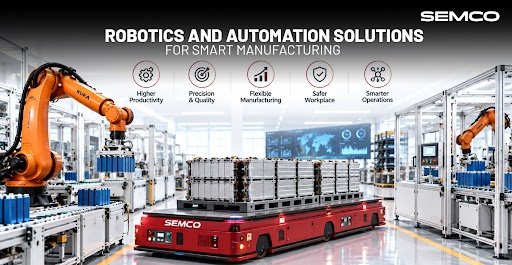
Robotics and automation are transforming modern manufacturing by improving production consistency, material handling, workplace safety, and operational efficiency. From robotic assembly and automated material movement to intelligent inspection and connected production systems, manufacturers are increasingly using automation to build faster and more reliable operations. According to the International Federation of Robotics (IFR), 542,000 industrial robots were installed worldwide in 2024, while India reached a record 9,120 industrial robot installations, a 7% increase from the previous year. For battery manufacturing and other precision-driven industries, robotics and automation can connect individual processes into a coordinated, data-driven production environment.
What Are Robotics and Automation?
Robotics and automation combine machines, control systems, sensors, software, and intelligent technologies to perform manufacturing and material-handling activities with limited manual intervention. Robotics generally involves programmable machines such as robotic arms, automated guided vehicles (AGVs), and mobile robots, while automation includes the broader systems that control, monitor, and coordinate industrial processes.
In a modern factory, these technologies can work together rather than operate as isolated machines. A robotic system can perform repetitive assembly or handling operations, while sensors and control software monitor process conditions. AGVs can transport materials between production stations, and connected monitoring systems can provide production data for operators and managers.
This integrated approach is particularly valuable in industries where precision, repeatability, traceability, and production speed are important. Instead of simply replacing a manual task, well-designed automation can improve the complete workflow by connecting equipment, people, material movement, and production data.
Why Robotics and Automation Matter in Modern Manufacturing
The growing adoption of industrial robotics demonstrates how manufacturing is changing. IFR reported that global industrial robot installations exceeded 500,000 units for the fourth consecutive year in 2024, while the worldwide operational stock reached approximately 4.66 million industrial robots.
For manufacturers, the objective is not simply to install more robots. The real value comes from selecting the right automation architecture for a specific production requirement. Automation can support repeatable operations, reduce dependence on manual material movement, improve process consistency, and provide better visibility into production performance.
In battery manufacturing, for example, automated systems can support material handling, cell and module assembly, inspection, testing, and movement between production stages. Automated equipment can also help manufacturers establish more consistent production processes as manufacturing volumes increase.
The benefits become particularly important when manufacturers need to scale production without allowing quality and process control to deteriorate. A properly engineered automation system can provide a foundation for that scalability.
Key Applications of Robotics and Automation
Robotics and automation can be applied across multiple manufacturing and industrial environments. Robotic arms can perform high-precision assembly, handling, welding, fastening, loading, unloading, and other repetitive operations. These applications can provide consistent movement and repeatable cycle execution when properly designed and maintained.
Automated Guided Vehicles are another important application. AGVs can transport materials, components, work-in-progress assemblies, and finished products between defined production locations. This reduces the need for operators to perform repetitive internal transportation and can help create smoother material flow across an assembly line.
Automation can also be used for inspection and quality-control processes. Sensors, cameras, testing equipment, and software can work together to identify process deviations and capture production information. When integrated with industrial control systems, this information can support faster troubleshooting and better process visibility.
Semco Infratech specifically describes its automation offering as combining robotics, IoT monitoring, and intelligent software, with applications including robotic assembly, SCADA-based monitoring, MES integration, and customized automation for cylindrical, prismatic, and pouch battery-cell manufacturing.
Robotics and Automation for Battery Manufacturing
Battery manufacturing requires controlled processes because cell, module, pack, and energy-storage production involve multiple precision-dependent stages. Automation can help manufacturers coordinate these stages while maintaining repeatability and traceability.
Robotics can be used for material handling, component placement, assembly, welding-related operations, inspection, and other production activities. AGVs can connect different workstations by moving components and assemblies between process areas. Data systems can then connect equipment-level information with higher-level production monitoring.
This becomes increasingly important as manufacturers move toward Industry 4.0 production environments. A connected factory can use equipment data to monitor production performance, identify process interruptions, and improve operational decision-making.
For battery manufacturers, the objective should therefore be more than purchasing individual robots. The automation system should be engineered around the production workflow, product dimensions, cycle requirements, safety requirements, quality controls, and future expansion plans.
Why Choose Semco Infratech for Robotics and Automation?
Semco Infratech focuses on industrial automation and battery manufacturing equipment, making its offering relevant to manufacturers looking for integrated production solutions rather than standalone robotic equipment. Its automation portfolio includes robotic assembly, IoT monitoring, SCADA systems, MES integration, AGVs, and automatic robots.
One of the key advantages of working with an automation-focused engineering company is the ability to consider the entire production process. A successful automation project requires more than selecting a robot. The system needs suitable tooling, sensors, controls, material-flow planning, safety systems, software integration, and commissioning.
Semco’s published automation solutions are designed around this broader approach. The company states that its systems are intended to improve productivity, reduce errors and downtime, and support Industry 4.0-ready manufacturing. Its AGV and robotic solutions are also positioned for intelligent material movement and precision tasks within assembly-line environments.
For manufacturers evaluating automation partners, the important questions should therefore include engineering capability, integration experience, application knowledge, scalability, after-sales support, and the ability to customize the solution around the production requirement.
How to Select the Right Robotics and Automation Solution
Choosing an automation system without first understanding the manufacturing process is a common mistake. Manufacturers should begin by defining the problem they want automation to solve. This could be repetitive material handling, inconsistent manual assembly, production bottlenecks, quality variation, workplace safety, or the need to increase production capacity.
The next step is to evaluate production requirements such as cycle time, payload, product dimensions, process accuracy, operating environment, available floor space, safety requirements, and expected production volume. These factors determine whether a robotic arm, AGV, conveyor-based system, collaborative robot, or a combination of technologies is appropriate.
Integration should also be considered from the beginning. The automation system may need to communicate with PLCs, sensors, SCADA platforms, MES software, testing equipment, databases, and other factory systems.
Finally, manufacturers should consider future scalability. A system that works for today’s production volume may become a limitation if the factory doubles its capacity. Good automation engineering therefore considers both current requirements and future manufacturing plans.
The Future of Robotics and Automation
Robotics and automation are moving toward increasingly connected and intelligent manufacturing systems. The growth of industrial robot installations, combined with developments in artificial intelligence, machine vision, IoT, autonomous mobile robots, and manufacturing software, is creating new possibilities for automated production.
IFR’s 2025 data show that India installed 9,120 industrial robots in 2024, placing the country sixth globally for annual industrial robot installations. The automotive industry represented 45% of India’s installations, demonstrating the increasing importance of robotics in Indian manufacturing.
The future will not simply involve adding robots to existing factories. More manufacturers are likely to focus on connected production environments in which robots, AGVs, testing equipment, sensors, software, and human operators work within a coordinated manufacturing system.
For companies investing in new production facilities or upgrading existing operations, the ability to integrate these technologies effectively will be an important part of building scalable and efficient factories.
Conclusion
Robotics and automation have become important technologies for manufacturers seeking greater production consistency, efficiency, safety, and scalability. From robotic assembly and automated material handling to AGVs, inspection systems, IoT monitoring, and MES integration, automation can transform individual production processes into connected manufacturing workflows.
Semco Infratech offers automation solutions focused particularly on industrial and battery manufacturing applications, including robotic assembly, AGVs, IoT monitoring, SCADA, MES integration, and customized automation systems. For manufacturers planning an automation project, the right approach is to evaluate the complete production requirement rather than selecting equipment based only on price or robot specifications.
With the right engineering, integration, and implementation strategy, robotics and automation can provide a foundation for more productive, connected, and scalable manufacturing operations.
Ideation by Manpreet Singh
Article Citations
- International Federation of Robotics (IFR), World Robotics 2025 – Industrial Robots.
- International Federation of Robotics (IFR), India Rises to Sixth in Global Factory Robot Installations, September 25, 2025.
- Google Search Central, Creating Helpful, Reliable, People-First Content.
- Google Search Central, Google Search Essentials.
- Semco Infratech, Automation – Smarter Manufacturing Through Automation.