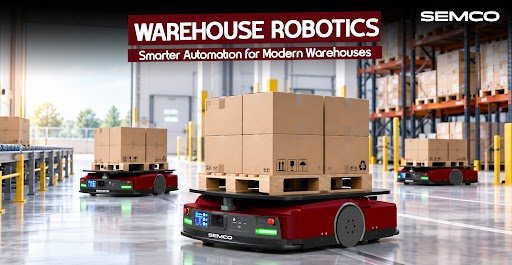
Warehouse operations are becoming more complex as businesses manage larger product volumes, shorter delivery expectations, increasing SKU counts and pressure to improve operational efficiency. Traditional manual material handling can struggle to keep pace with these demands, particularly when repetitive movement, sorting, picking and transportation consume significant time and resources. Warehouse robotics provides a way to automate these activities using technologies such as Automated Guided Vehicles (AGVs), Autonomous Mobile Robots (AMRs), robotic arms, machine vision and intelligent control systems.
Modern warehouse robotics is not simply about replacing manual work with machines. The real objective is to create a connected material-flow system in which robots, warehouse processes, software and human workers operate together. Recent industry research also highlights the growing role of AI, robotics and physical automation in warehouse operations.
What Is Warehouse Robotics?
Warehouse robotics refers to the use of automated and intelligent robotic systems to perform material-handling and logistics activities inside warehouses and distribution facilities. Depending on the application, these systems can transport materials, move pallets, support picking operations, sort products, perform repetitive handling tasks and assist with loading or unloading processes.
AGVs generally follow predefined routes or guidance systems, while AMRs can use sensors, mapping and autonomous navigation to adapt to changing environments. Robotic arms can be integrated for repetitive handling, palletizing, picking and other precision operations. Machine vision can further support identification, inspection and positioning tasks.
The Government of India’s warehousing standards handbook identifies applications including autonomous forklifts, picking systems, heavy carrier systems, machine-vision applications, robotic palletization and AGVs within warehouse robotics.
Why Is Warehouse Robotics Important for Modern Warehouses?
The biggest advantage of warehouse robotics is the ability to make repetitive material movement more consistent and scalable. Robots can support continuous movement of materials between storage areas, workstations, staging locations and production zones while reducing dependence on manual transportation.
Warehouse robotics can also help organizations improve operational visibility. When robotic systems are connected with warehouse management, manufacturing or monitoring software, businesses can obtain better information about material movement and task execution.
Safety is another important consideration. Properly designed driverless industrial truck and AMR systems need to account for obstacle detection, stopping functions, operating zones and interaction with people. ISO 3691-4:2023 provides safety requirements and verification methods for driverless industrial trucks and their systems, including AGVs and AMRs.
Major Types of Warehouse Robotics
Warehouse automation can involve several types of robotic technologies depending on the facility layout and operational requirements.
Automated Guided Vehicles (AGVs) are commonly used for predictable transportation routes. They can move components, containers, pallets and other materials between defined locations.
Autonomous Mobile Robots (AMRs) use onboard sensing and navigation technologies to move through dynamic environments. Their flexibility can make them useful where routes or workflows change frequently.
Robotic arms can perform repetitive handling, palletizing, depalletizing, sorting and other precision tasks. When combined with machine vision, they can identify and manipulate objects based on defined parameters.
Automated forklift and heavy-load robotic systems can support movement of heavier materials while reducing the need for manual vehicle operation in suitable environments.
The correct technology depends on factors such as load weight, warehouse layout, travel distance, floor conditions, required throughput, safety requirements and integration with existing systems. Simply installing robots without evaluating these factors can produce poor results.
How Warehouse Robotics Improves Material Flow
An effective robotic warehouse is built around material flow rather than individual machines. For example, an AGV or AMR can collect material from one location, transport it to a workstation and return for another task. A robotic arm can then handle or process the material before another automated system moves it to the next stage.
This approach can reduce unnecessary movement and help create a more predictable workflow. Fleet-management software can coordinate multiple robots, allocate tasks and manage traffic so that individual machines operate as part of a larger system.
Research into warehouse and logistics robotics identifies multi-robot coordination, task allocation, fleet management, human-robot collaboration and interoperability as important areas for modern robotic systems.
Why Choose Semco Infratech for Warehouse Robotics?
Semco Infratech develops automation solutions involving robotics, IoT monitoring and intelligent software. Its automation offering includes robotic assembly, AGVs, automatic robots, monitoring systems and MES integration, with an emphasis on connected and scalable industrial automation.
One relevant capability is its use of AGVs and automatic robots for material movement and automated processes. Semco describes AGVs as autonomous mobile systems designed to transport materials and components between production stages, while robotic systems can support precision activities such as component placement, handling, fastening and inspection.
This makes Semco Infratech a relevant automation partner for businesses that need more than an isolated robotic machine. A successful warehouse robotics project may require evaluation of material flow, robot selection, navigation, safety, control systems, software integration and future scalability. An engineering-led approach is therefore important when designing the complete automation system.
What to Consider Before Implementing Warehouse Robotics
Businesses should not select a robotic system based only on robot specifications or purchase price. The first step should be understanding the actual warehouse workflow.
Important considerations include the type and weight of materials, number of SKUs, movement frequency, travel distances, warehouse dimensions, floor conditions, rack configuration, human traffic, required throughput and integration requirements.
Safety should also be treated as a system-level requirement rather than an optional feature. ISO 3691-4:2023 specifically addresses safety requirements for driverless industrial trucks and their systems, while current international work is already progressing toward a newer revision.
Finally, companies should evaluate scalability. A robotic system that works for today’s workload but cannot accommodate additional robots, new workflows or higher throughput may become a limitation rather than an advantage.
The Future of Warehouse Robotics
Warehouse robotics is moving toward increasingly connected systems in which robotics, artificial intelligence, sensors, software and human workers operate as one coordinated environment. Gartner’s 2026 research identifies physical AI as an emerging supply-chain technology combining AI models, IoT sensors, robotics and automation for real-time sensing, analysis and execution.
Gartner has also highlighted physical AI agents for warehouse activities such as picking, packing, sorting and material handling, while emphasizing the importance of human oversight.
For warehouse operators, this means the future is unlikely to be about buying a single robot and calling the facility automated. The greater opportunity lies in designing an integrated system that connects robotic transportation, handling, sensing, software and operational decision-making.
Conclusion
Warehouse robotics is becoming an important part of modern material handling because it can support consistent transportation, repetitive handling, improved workflow control and scalable automation. AGVs, AMRs, robotic arms, machine vision and intelligent software each have different roles, and the right combination depends on the warehouse’s operational requirements.
Semco Infratech’s published automation capabilities include AGVs, automatic robots, robotic assembly, IoT monitoring and MES integration, providing a foundation for businesses looking to develop connected industrial automation solutions.
For organizations considering warehouse robotics, the priority should be selecting a solution based on measurable operational requirements, safety, integration, scalability and long-term system performance—not simply choosing the most advanced-looking robot.
Ideation by Manpreet Singh